The following description of Pope Innocent III’s world was first published in the second issue of New Polity, a journal dedicated to doing the theological and philosophical work necessary for building Christian societies during and after liberalism’s collapse. Please subscribe.
Pope Innocent III (r. 1198–1216) is one of the most studied popes of the Middle Ages, largely because of his role in the drama of defining the relationship between the spiritual and temporal powers. Through the first half of the 20th century, Innocent was treated overwhelmingly as a political pope who extended the temporal power of the papacy to its High Medieval apex. This reading was challenged in the latter half of the century by a generation of historians who emphasized Innocent’s pastoral concerns and his innovations in the Church’s efforts at spiritual reform. These historians asserted that Innocent sought to extend the reach of the spiritual power. These two readings have been presented in opposition to each other, most famously in the collection of essays titled Innocent III: Vicar of Christ or Lord of the World?—a collection that remains a starting point for study of the pontificate and so for study of Church/state relations generally. Getting Innocent right is crucial to getting the medieval papacy right, which is essential to understanding the Church’s tradition of the two powers.
Neither of these readings of Innocent are adequate. Both approach him with the goal of placing the pope within one of modernity’s classic narratives, that of the centuries-long conflict between Church and state, a narrative that spans from Constantine to the Wars of Religion and which concludes with the establishment of the secular state and privatized religion. Both slide Innocent’s political thought into this narrative largely on the basis of a handful of his decretals; texts that happened to have made their way into later canon law collections and so were deployed throughout the late Medieval and early Modern periods. If these canons are approached in isolation and read through lens of their later use in conflicts between popes and kings, and if modern notions of sovereignty, statehood, and even legal positivism are unproblematically applied to his pontificate, we can understand why Brian Tierney would assert that these texts “are very difficult to understand unless we assume that Innocent did believe in a theocratic idea of papal world-monarchy.” [1] In other words, if we assume that the world is the type of thing that is necessarily ruled by a lord, we are almost compelled to conclude that Innocent believed that he was “Lord of the World.”
This reading of Innocent as a modern sovereign is defended through particular interpretations of Innocent’s two most famous arguments for the superiority of the priestly over the royal power. The first is his comparison of the priestly authority to the sun and the royal power to the moon. The moon, of course, derives all its light from the sun. Modern interpreters read this as a delegation or commission from the sun to the moon, from the priestly to the royal, as if from a general to a junior officer in an army. Whatever the royal has, the priestly has given it and so, presumably, kings must obey priests and the priesthood holds the power to take the royal power away. The second argument is Innocent’s assertion that the priesthood, through the papacy, can intervene in the affairs of a king wherever there is sin. This is the famous claim of ratione peccati—on account of sin—and it is often understood as some sort of a Schmittian capacity for the sovereign decision. If the pope can intervene wherever there is sin, and if he is the only judge of sin, then he can intervene whenever and wherever he wills. All other orders of social power lay under his continuous threat of suspension and so must be understood as extensions of his will.
The scholars stressing Innocent’s pastoral concerns are not so much interested in disputing this interpretation of Innocent as asserting that he was more concerned about the salvation of souls than he was worldly power; that he was only interested in such complete worldly power so that he could better save souls. They are not so much challenging Innocent as “Lord of the World” as they are claiming that this lordship was not cynical but well-intentioned and aimed at moral reform.
There is a serious theoretical error being made here, namely, the essentialist treatment of the categories of modern statecraft. Historians assume a flat, neutral, and ultimately static playing-field on which the game of political history is played. The game itself concerns the construction of mechanisms of power and control that extend across the field. While these mechanisms can be made and destroyed, with new strategies being deployed by new players, the underlining rules of the game are themselves fixed and timeless. Questions such as “what are the powers of the king and what are those of the pope?” may be given a variety of answers, but the formation and analysis of these answers is necessarily couched in modern, constitutional and positivist categories. Within this line of thought, a particular list of powers can be enumerated objectively and without reference to particular circumstances. The relative powers of the king and of the pope can be stated as a possible positive constitution—as if they were branches of our states. The players of the game are always construed as attempting to construct a mechanism that would increase their relative power and enshrine it in a static and timeless constitution. Within this matrix of assumptions, the task of the historian trying to get to the bottom of Innocent’s political thought is to lay the pope’s various assertions out next to each other and see if he can assemble them into a consistent, stable, and positive doctrine of papal and royal power, which is really just a version of a secular constitution. Contradictions or inconsistencies that might emerge within such a proposed constitution are considered anomalies, failures in the rigor of thought, or cynical diversions. Innocent’s thought is in this way read into a flat, timeless, and univocal “political” field within which power accumulation is understood as the universal objective because power is necessarily what orders the game: relative worldly power is the “score” of the game, and the victor is he who succeeds in dominating his opponents.
This is all wrong. Innocent’s world was not flat, timeless, and univocal. Christendom was dynamic, hierarchical, temporal, and analogical. It moved, governed by a master narrative of fall and redemption, sin and grace, law and freedom, the external and the internal, the temporal and the spiritual. Its meta-narrative was that of salvation history, the movement from paradise, through the stages of the Old Testament, into the New Testament, and on to the eschaton. History was not played out on a static field, with winners and losers emerging and vanishing within fixed rules. History was the field. Making the rules was the game. Nothing lay outside of it because it extended analogically from creation to glory, from inanimate matter to God Himself. The master narrative was not, then, merely rhetorical, or ideological, or pedagogical. It was metaphysical.

The master narrative of Christendom built the phenomenological world in a fractal manner, retaining its integrity as it structured human life at different levels of scale, from the totality of history, down to a single act of a single person. The plot line was a plot of ascent from the lower to the higher, through a hierarchy of increasing fulfillment through increasing participation in the life of God. This was not a linear ascent of ontological sameness, wherein one stage transitions to another, like an elevator slowly moving between floors. Rather, the ascent was one of analogical intervals, which could only be bridged from above, the ultimate foundation and type of which was, of course, the analogy between creation and God Himself, concerning which Innocent III’s Fourth Lateran Council (1215) stated: “between creator and creature there can be noted no similarity so great that a greater dissimilarity cannot be seen between them.” [2] The movement of ascent was an ontological movement from less to more intense being, a movement deeper into participation in being itself.
At its most fundamental level, the world was never static. Innocent’s cosmos was the world that the Church had come to inhabit through her 1,200 year life. Innocent was not novel. He did not articulate this world as a theoretical concept or build it as a utopia within some other, non-Christian landscape that afforded him the opportunity of describing it as an object. He lived in this world. Nevertheless, he was profoundly ambitious and so he can show us this world at its most bold.
The Senses of Scripture
The four senses of Scripture permeate this period’s thought. These four senses were, in their most common iteration, the historical, the allegorical, the tropological, and the anagogical. In modern treatments they are often described as parallel glosses to the Scripture text: The historical is the literal meaning (temple is the temple); the allegorical is how the text points to Christ and his Church (the temple is Christ); the tropological sense is the text’s application for the moral life (the temple is the heart of the believer) and the anagogical sense is how the text reveals the final destiny of the soul in heaven (in heaven there will be no temple because the Lord God and the Lamb will be the temple). [3] The historical was the literal sense while the last three senses together were the spiritual senses.
This scheme conceals how the senses were understood in the 12th century. As Henri De Lubac showed us, the four senses were dynamically related to each other in a movement of ascent to God. They were not merely glosses to the Word of God, the Bible; they were ascending levels of participation in reality, understood as the creation of the Word of God, Jesus Christ. In fact, there were no hard lines between the Word as text and the Word as the hidden life of the world. Again, the master narrative of Christendom simply was salvation history. They lived in the Scriptures, and so the senses of Scripture could only be a way of living and being, never merely a way of reading. [4] The historical was the world of things and events. This world was created by the Word of God, but it was not made out of God. It was the world of matter and time, of the material causes of things. Because it was made by God, however, all matter bore the trace of God; of a love which desired things to be and ordered them towards their good. [5] This meant that the Incarnation of the Word did not simply add a layer of meaning to history. Rather, Christ revealed history to be what it really was in a way that could never have emerged out of history itself, as an architect reveals what a home that bears his trace is for—by living in it. The entry of history’s author into history in no way detracts from its real historicity. The ideas of all things were in the Word, and the Word had entered history from above. This sense of the historical world as being in-formed by the Word was the allegorical sense, in which history was read through Christ. The allegorical was about the formal cause of things, a higher cause that yet entirely presupposed the material—the ideas in the mind of Christ by which He actively forms created matter into the form-matter beings that we know and love as the “things” of this world. The allegorical included the material-historical and so the allegorical was the totality of the objective content of reality. As Hugh of St. Victor explained, the allegorical sense included everything that Christians knew. [6] To live within the allegorical sense was the intellectual component of being a Christian. It concerned the intellect, for only the intellect can penetrate to the immaterial forms of things, knowing reality as allegorical—as being in-formed by divine ideas. Thus, the allegorical sense was only perfected in faith, the virtue of the intellect. As St. Bernard said, “You leave the fleshy sense and move to an intellectual understanding, from a fleshly servitude to the freedom of spiritual understanding.” [7]
But this faith was dead until it was internalized in the believer; until he conformed himself to Christ in thought and deed. The “idea” of Christ could not even really be held, but only intellectually anticipated; it had to be lived. This was the move to the tropological, wherein the objective content of the faith became subjectively realized in the Christian through the life of charity, the fulfillment of nature—the final cause. The tropological concerned the will and goodness. St. Bernard asserted that the entire Gospel could be interpreted “according to tropology, so that what has preceded in the head may consequently also be believed to come about morally in its body.” And again: “We have gone across the shadows of allegories, the time has come to explore moral matters; faith has been built up, let life be provided for; the understanding has been trained, let the action be rehearsed and enriched.” [8] As Innocent would explain, “we require not only allegory, which instructs the soul in knowledge, but even more tropology, which instructs the soul to salvation.” [9]
The tropological was not parallel to the allegorical. Rather, the Christological reading of reality became living, became more completely itself, in the internalization of the faith in the saint. The life of the saint—not a discussion of sanctity, but sanctity itself—was the tropological sense of Scripture. The tropological sense of Scripture was Scripture preached in word and deed—it was Scripture alive, which is to say, it was Christ dwelling in and through his saints. It was the Church. As with the gap between the material and the allegorical, the gap between the allegorical and the tropological was only bridged analogically from above, through grace. The allegorical was an image of the tropological, like how a portrait is an image of a man. In the tropological, then, what happened historically and was understood allegorically happened again and more perfectly in the life of the believer, spiritually. As the Medievals would say, all days become today, [10] and as Innocent simply and repeatedly stated “what happened in the Old Testament, happens again in the New.” [11] The glossa ordinaria, the standard Bible commentary of the period, commented on the sacrifices mandated in Leviticus: “We offer a calf when we conquer the pride of the flesh; we offer a lamb when we correct our irrational movements; we offer a goat when we conquer our lasciviousness; we offer a turtledove when we preserve our chastity; we offer unleavened bread when we eat the unleavened bread of sincerity.” [12] The allegorical meaning of the Old Testament only became real, or even finally true, when it was lived in the New Testament, tropologically.
The goal of this movement was the complete congruency of the objective and the subjective with the source of both, which was perfect contemplation, achieved through the elevation of a perfect understanding of and perfect conformity to Christ into the very life of God. This was the anagogical, that which was always hoped for, and which was anticipated in the allegorical and tropological, but which was never quite achieved in this life. This was deification, the object of Hope, achieved only through grace. In the anagogical, Scripture was surpassed because it was fulfilled through unmediated participation in the very Word of God itself. The tropological was a participation in and an image of the anagogical. The anagogical was heaven, the most intense participation in being possible which lay across the most profound analogical interval.
The spiritual senses—the allegorical, tropological, and anagogical—were not superlative senses. They were not super-added onto a self-sufficient historical sense. Rather, knowing what a thing was and acting on it appropriately were only achievable through the spiritual senses. The integration of these senses had formed Adam’s world. With the fall, man had not abandoned the allegorical and tropological. Rather, he had posited his ideas as the natures of things and his “knowledge of good and evil” as the goodness to which they aimed. After the fall, this was the condition of fallen nature, this was the condition that Christ’s gratuitous interventions sought to undo. The historical sense, then, unfulfilled in the spiritual senses, was a world of sin and idolatry.
This approach to the senses of Scripture was the expression of a complete world, a world of matter and form, of objects and subjects, of time and eternity, of the natural and the supernatural, of law and grace, of the intellectual and the volitional, united in a single dynamic—which was as metaphysical as it was practical. There is ultimately only one sense of Scripture, the anagogical, perfect contemplation, the communion of the soul with creation and with God, which is perfect charity and perfect peace, and so includes perfectly one’s fellow men: it is the perfect Church, head and members, triumphant. But it was anticipated, as Rupert of Deutz said: “to comprehend the mysteries of Scripture in mind and in life is already to reign in the kingdom of God.” [13] Each of the lesser senses were related to the anagogical within the analogical “similarity so great” and set off through the “greater dissimilarity.” No amount of history ever transitioned to allegory and no amount of allegory every transitioned to tropology. Rather, history was elevated into allegory and allegory into tropology, even as they retained their identity. For example, the saint did not stop knowing because he was truly living, in fact his knowledge was perfected. The senses, therefore, formed a dynamic unity. No true move into the allegorical, into faith, could happen without a move into tropology, into charity, which was inseparable from the hope for anagogy. Through grace, as one came to understand, one came to desire to interiorize, and as one interiorized, one was capable of greater understanding. The theological virtues had an order to them, but they were nevertheless inseparable. Christ could not be fully understood in his truth until he started to be loved in his goodness and he could not be loved until some fleeting experience of his beauty had been granted. Hope, the anagogical, initiated the movement even as it posited the end of the movement. Perfect charity was the end, and yet the first movements of charity were what grace made possible at the beginning. The dynamic, though, was up, through the senses, and so to God, the greatest of the “greater dissimilarity,” which was the source of all “similarity so great.”
This was the dynamic of conversion that was lived not only in the life of the contemporary faithful, but was expressed clearly in salvation history itself: from simple history in nature, to history under the law which pre-figured Christ and so brought the movement into faith, to history under the New Law of grace, which brought the internalization of the law in charity, to ultimately glory, the heavenly Jerusalem. Through the dynamic of law and grace (the allegorical and the tropological, the Old and the New), the faithful moved from sin, through instruction, to virtue, and so to salvation. As Innocent explained, there were four transgressions: First, was the sin in paradise; second, was the sin against the natural law; third, was the sin against the written law; fourth, was the sin against the Gospel. These historical transgressions were in the individual the sins of weakness, ignorance, negligence, and spite, respectively. [14]

We sinned against the Father in our weakness, against the Son in our ignorance, and against the Spirit in our malice. These corresponded to our transgressions against the law of nature, against the law of Scripture, and against the law of grace. These were manifested historically in Cain, the golden calf, and contemporary corruption. These were were nothing else than sin in the heart, sin in the mouth, and sin in life, which were the three dead people that the Lord raised—the corpse in the house is sin in mind (Luke 8:54–55), the corpse at the gate is sin in speech (Luke 7:12–15), and the corpse in the tomb is sin in action (John 11:41–44). [15] The salvation of Christ came in the same pattern, coming to Abraham only in word, to David in law, and to Mary in life—which was, of course, the movement from the historical, to the allegorical, to the tropological: from sin to knowledge to virtue. [16]
We might conceive of the dynamic as an ascending spiral, an always circling back, but always at a higher level. But, nevertheless, the whole of Revelation is being recapitulated, is being “re-lived” at a higher level, with the conclusion laying always just out of reach, and regardless of how far one has progressed in this life, all four of the senses co-exist. They each exist both in their simple form (wherein they are the most distinct, awaiting elevation into the higher senses) and in their perfected form within the higher senses. There remains always history to be elevated into allegory and always allegory into tropology because anagogy remains always beyond. It is what drives the whole ascent and so it is necessarily what lays always just out of reach, ever receding in God’s ever greater difference, and yet it is equally necessary at the beginning, in God’s similarity however great. As Henri de Lubac summed up the high medieval understanding:
Each day, deep within ourselves, Israel departs from Egypt; each day, it is nourished with manna; each day it fulfills the Law; each day it must engage in combat; each day the promises that had been made to this people under a bodily form are realized spiritually in us. Each day also the Gentiles give themselves over to the worship of their idols; each day the Israelites themselves are unfaithful; each day, in this interior region, the land devours the impious… Each day again, there is the Lord’s visit; each day, he approaches Jerusalem… each day is his advent. [17]
The senses provided a way to describe the world in a manner that did not suppose it to be stationary or univocal. Any particular thing or event could be approached through the historical, the allegorical, or the tropological and there was always something to say, but it was never all there was to say. It was never complete because everything was moving toward either its final completion or its final perdition. Each sense, to the extent that it was “full,” contained within it the fulfillment of the lower sense and the anticipation of the higher sense. Each sense was unstable and could only finally be through its undermining, either up or down, either being perfected or being perverted, because finally all things “settled” only in God, the “greater dissimilarity.” The meaning of Scripture was bottomless, but so too was the meaning of the world that Scripture described and built.
One of the obvious things that this reading of the four senses of Scripture reveals is the extent to which they were wrapped up in the spiritual life of the believer and so of the Church. [18] The Church was not a passive “reader” of the Bible. Rather, the Church lived Scripture, and Scripture’s senses corresponded to the Church’s ability to receive those senses, that is to say, to the extent to which it had conformed itself to Christ. The extent to which it was the Body of Christ was the extent to which the higher sense was revealed. We can say, I think, that the senses emerged out of Scripture only at the point at which the believer was ready to receive them because his reception of them was integral to them. [19] In the first of St. Bernard’s great tropological sermons on the Song of Songs, he stated to his audience of monks:
You, my brethren, require instruction different from that which would suit people living in the world, and if not in matter, in manner, at least. For a teacher who would follow the example of St. Paul, should give them “milk to drink, not meat.” But more solid food must be set before spiritual persons, as the same Apostle teaches us by his practice. “We speak,” he says, “not in the learned words of human wisdom, but in the doctrine of the Spirit, comparing spiritual things with spiritual.” … Just as the eye that is blind or closed cannot profit by the light poured upon it, “so the animal man perceiveth not those things which are of the Spirit of God.” [20]
Scripture’s abundance is, of course, the way all loving language works. It gives more than the recipient is capable of mastering; it communicates in surplus, so that the recipient can move deeper into its truth. But it does so in a way that does not assault the recipient with his ignorance or lack of perfection, but rather makes use of what understanding and perfection is there in order to expand and elevate it. As St. Bernard explained to his listeners: “Sometime even during the sermon it seems to me that I can actually feel the burning fervor of your hearts. For the more plentifully you suck out the milk of the word, the more abundantly does the Holy Spirit replenish my breasts; and the more speedily you swallow down what is offered, the more copious the supplies given to me for your nourishment.” [21]
St. Gregory the Great, for example, explained the inability of the two disciples on the road to Emmaus to recognize Christ, not on account of Christ unilaterally hiding himself, but rather to their being unable, because of a lack of faith, to recognize him:
The Lord enacted outwardly, before their physical eyes, what was going on in them inwardly, before the eyes of their hearts. For inwardly they simultaneously loved him and doubted him; therefore the Lord was outwardly present to them, and at the same time did not reveal his identity … he simply showed himself to them physically exactly as he appeared to them in their minds: as a stranger, and therefore as one who would pass on.
The deficiency was within them. The deficiency began to be removed, however, as Christ expounded the allegorical content of Scripture. This deepened faith was not adequate, however. Their vision was not healed until they moved to charity (the tropological) by pressing Christ to stay with them, an act of hospitality which culminated in the breaking of the bread and the full recognition of Christ. “Consequently,” Gregory writes, “they were not enlightened by hearing the precepts of God, but by doing them.” Indeed, “Whoever wishes to understand what he hears read out in church, should hasten to carry out in his actions those things which he understands already.” [22] Progress in the senses of Scripture was at the same time progress into faith, charity, and hope—that is to say the convergence of the intellect (allegory) with the will (tropology) in the eschatological “breaking through” of the Incarnation (anagogy)—it is only then that Christ is fully recognized. The “meaning” of Scripture is therefore ultimately a performance, in word and deed, and Christian life is ultimately a re-living, even an incarnation, of Scripture. This is the essence of sacramental liturgy.
This ultimately liturgical convergence of the dynamics of his world and that of the Scripture narrative is of the utmost importance in understanding Innocent, because it allows him to read the world around him constantly through Scripture. He saw everywhere people stuck in the realm of simple history, stuck in the realm of the merely carnal, and so laboring in servile fear and suffering in sin; it was the mission of the Church to preach the objective contents of the faith, the law, to these people, and through the Sacraments to bring them the grace necessary to move out of mere history, through faith, to the liberty of charity, and ultimately, to salvation. This was the perpetual, fractal repetition of the biblical narrative in the here and now. This was a profoundly monastic conception of reality. And through it, the present could be read, must be read, through Scripture. The application of Scripture to the world was the building of the world as coherent and as a world capable of modification, or reform. Divine Revelation gave Innocent the framework on which the world of things and events must be arranged and so understood within the progress of salvation. The pastoral and the political were the same thing. They were integral to a cosmology.
Through its multiple senses, Scripture allowed Innocent to interpret the world in all its dynamic complexity. The actual world in which he lived could be read through what he called the “four levels of theological interpretation.” Jerusalem, for example, was understood according to history, allegory, tropology, and anagogy, that is, the “superior,” the “inferior,” the “interior,” and the “exterior,” which were heaven and earth, spirit and body. The superior was the Church Triumphant. The inferior was the Church Militant. The interior was the faithful soul and the exterior was miserable Jerusalem in Syria. Jerusalem offered a peace that was appropriate for each of these meanings. [23] Innocent could move from Jerusalem in any of these four directions or he could move from any of these meanings back into Jerusalem and through it to the other meanings. Any discussion of reform could move to crusade. Any discussion of heaven could move to earth. Any discussion of sin could move to peace—always through revelation, Christ.
In his treatise on marriage, Innocent used the structure of marriage as he experienced it in his own day, with its rings, dowries, best men, and so on, as the historical jumping-off point for a discussion of the allegorical: Christ’s marriage to the Church; the tropological: the marriage between God and the just soul; and the anagogical, the marriage between the Word and human nature. Material marriage was the historical thing that was ordered by the externals of the law, through which it was elevated by grace, to the fulfillment of humanity. [24] This was a way of describing what a sacrament was, and each sense “reached” out into a certain region of the human experience and connected it through the sacrament to all the others.
Innocent treated the Mass similarly in his famous commentary on the Missal. The objects and movements of the liturgy as well as the people who participate were presented as the literal or historical that was to be interpreted spiritually. In reading the Mass in such a way, Innocent was capable of uniting the entirety of salvation history, the spiritual life, and the hierarchical order and practices of Christendom within the single mystery of the altar, which was, as Innocent reminds us, the sacramental perpetuation of the Incarnation itself, and a foretaste of heaven. As Innocent explained: “Since Christ exists in things according to his Divine nature in three ways—in everything through essence, in only the just through grace, and in men assumed through union—he wanted likewise to exist in things according to his human nature in three ways—locally in heaven, personally in the Word, and sacramentally on the altar.” [25] And, “the order [of the Mass] is correct, that after preaching would follow faith in the heart, praise in prayer, fruit in work: faith in the Creed, praise in the offertory, fruit in the sacrifice.” [26] All of salvation history was contained within the liturgy. For example, Innocent explained, the actions of the subdeacon were the allegorical, the law, while those of the deacon were the tropological, the gospel, and those of the priest were those of Christ himself, the anagogical. [27]The liturgy was cosmological. It was where all the pieces came together because it was where the anagogical actually broke into the world from above. The Mass was a master hermeneutic. [28]
For Innocent, long before Derrida, the world was a text. One had to read the world in order to work in the world, and one’s work in the world was always work within the text. Innocent, for example, opened Lateran IV with such a reading. [29] He preached a sermon on the text of Luke 22:15, where at the last supper Christ says to the apostles: “I have earnestly desired to eat this Passover with you before I suffer.” It was Innocent himself who had earnestly desired to eat this Passover with the assembled bishops. As Innocent preached, in the same way that Josiah, in the eighteenth year of his reign restored the temple and celebrated the Passover, he, in the eighteenth year of his reign (which it was), would restore the “the Temple of the Lord,” which was the Church, and the Passover, which Innocent now identifies as the council and its work, would be celebrated. Josiah was, of course, the last good king in the line of David. At the very brink of exile, Josiah attempted to restore temple worship and to enforce the law of Moses. When he had completed extensive reforms, eliminating idols and re-instituting the law, he held a massive Passover celebration. This Passover was an attempt at renewing the covenant between Israel and the Lord. Innocent was Josiah, and the Church was the temple, the place where God dwelled with man through liturgy. The reforms of the council would be a renewal of the covenant with God. Innocent, the new Josiah, would lead the new Israel, to the proper observance of the new covenant, through the new Passover, which was, of course, the very paschal mystery of Christ Himself. This profoundly Scriptural understanding of what was going on became pronounced and specified as Innocent’s sermon progressed. Innocent asserted that the Passover that they were celebrating must be understood in three senses: the physical—the liberation of Jerusalem through crusade; the spiritual—the reform of the Church; and the eternal—salvation itself.
Paraphrasing Lamentations, Innocent depicted Jerusalem as it lay under Muslim rule crying out as the conquered Jerusalem of Jeremiah: “O all you who pass along the way, listen, and see if there is any sorrow like my sorrow. Then pass over to me, all you who love me, so you can free me from my great misery. For I, who used to be the mistress of nations, have now been made a slave.” The physical, literal Jerusalem must be physically, literally saved through a historical passing over to the Holy Land. Using Ezekiel’s visions of the impending destruction of Jerusalem, Innocent proceeded to call for the moral reform of the Church, led by the clergy who preached through the grace of the Holy Spirit and so marked a Tua on the foreheads of those who converted and so were spared, while cutting down the wicked with the sword of interdict and excommunication. Here Jerusalem (most especially the temple) is the Church and virtues are the mark made on the remnant that are to be “passed over.” But the clergy cannot save even this remnant without first becoming themselves the man “dressed in linen,” the man of robust virtue. The sermon culminates in Innocent’s treatment of salvation, “the eternal Passover.” It was this Passover above all that Innocent desired to eat with the fathers, and the meal could be understood either spiritually or corporally. The spiritual and corporal came together in the Eucharist: “Of the Eucharist it is said, ‘He that eats me shall live because of me;’ of eternal glory it is read, ‘Blessed is he who will eat bread in the kingdom of God.’”
Innocent began his sermon with the words of Christ at the Last Supper, and he ended it with the Eucharist—the perpetuation of the eternal sacrifice temporally—while in between came the mission of the Church in history, which was interpreted through salvation history. The mission of the Church was read from within the same system of meaning as the Scripture. But more than that, it was integral to that meaning: Innocent was telling us what the end of the monarchy and the beginning exile meant as much as he was telling us what the Church was. The meaning of Scripture was alive in and through the history-bound life of the Church. This is not a series of metaphors. He was telling us what the Passover itself means and it is a meaning that is always immediately relevant because its meaning is ultimately Christ Himself. Innocent had given his council two primary tasks, crusade and reform of the Church. [30] He was here explaining how these two were really different senses of the same text, how they flowed out of who the Church was as a liturgical, Eucharistic reality dynamically interacting with the world at different levels of perfection within a single narrative. The one Church was simultaneously the sword in miserable Jerusalem and the law and grace in the ecclesial Jerusalem even while moving toward the glory of the heavenly Jerusalem, anticipated on the altar.
Innocent’s political or social thought must be understood within this framework. Innocent divided his society into three orders: the married, the celibate, and the ordained. These were the three Magi who came to Christ through the “evangelical preaching” of the star, to find him in the house of the Church and offer him the three gifts of faith, hope, and charity. [31] Mary Magdalene, Mary the mother of James, and Salome represented these three lives: lay, regular, and clerical. As Innocent explained, “The lay life should anoint the feet of Jesus, the regular life the head, and the clerical life the body. For the feet of Christ are the poor, the head is the divinity, and the body is the church.” The laity constructed the Church through the corporal works of mercy, the regulars through prayer, and the clergy through word and example. [32] This conception reached perfection in the Mass. There were three orders of guests, Innocent tells us, at the wedding feast, the prelates, the continent, and the married, and three types of people participated in the Mass, namely the celebrants, the ministers, and the people who surrounded them. [33] Together, these orders constituted the Body of Christ. Society was liturgical. The three orders aligned with the senses of Scripture: the laity with allegory; the clergy with tropology; and the religious with anagogy. They, therefore, constituted a hierarchy of ascent wherein contemporary social order was constituted within the Biblical narrative of fall and salvation. The social order was animated by the same dynamism that animated the senses of Scripture.
Priesthood

In order to understand his approach to relations between the three orders, we have to understand Innocent’s account of the biblical narrative. For Innocent, contemporary kingship and priesthood were both instituted by God and both descended from the Incarnate Christ. Innocent is clear on this point. Christ’s kingship and his priesthood are, following Hebrews, of the order of Melchizedek, “king of Salem, priest of the Most High God.” [34] The unity of kingship and priesthood in Melchizedek, therefore, book-ends the story of salvation history, with the historical Melchizedek at one end and Christ, the restored Melchizedek, at the other. Indeed, Innocent goes so far as to refer to the offering of bread and wine by Melchizedek in Genesis as the evangelical sacrifice, which came before the sacrifices of the Old Law: the Gospel was, in a sense, both before and after the law. [35] The Old recedes and the New succeeds, but the order of Melchizedek endured. [36]
This foundational unity of kingship and priesthood, however, was not an equality. Melchizedek was king of a city and priest of the divinity, and so there is as much distance between the priesthood and the kingship as there is between the civil and the divine. The priesthood was higher in dignity, Innocent tells us, as the soul is higher than the body. Kingship concerned things and bodies, the external, while priesthood concerned the soul, the internal. [37] Historically, Melchizedek, for example, was the king only of Salem, but he was a universal priest of the most-high God. The material is divided, particular, and temporal, while the spiritual is unified, universal, and eternal. This distinction played out in the division of kingship and priesthood under the law. Following Hebrews, Innocent argued that the Old Testament priesthood was grounded in Melchizedek’s blessing of Abraham and so was properly understood as below the priesthood of the priest-king himself. Even so, the Levitical priesthood was prior to the establishment of the monarchy and so higher than kingship. What is more, the Levitical priesthood was instituted by the initiative of God whereas the monarchy was instituted only after the clamoring of the people, and the priests anointed the kings. [38] Even though both the priesthood and the monarchy of the Old Testament were in some manner derived from the unity of the historical Melchizedek, the priesthood was higher because it reached beyond history, participating in the universal, even if only in anticipation—allegorically.
This does not mean that the priesthood was superior in a political, univocal sense during the Age of Law. To the contrary, Israel was a priestly kingdom—its sacerdotal character modified its primary identification as a kingdom. If the Age of Law was the allegorical age, we might say that its priestly character was that part of the allegorical that pointed beyond itself, that grasped after its fulfillment in the tropological. The sacraments of the Old Law were true figures of the sacraments of the New. Israel’s royal character, however, was the allegorical proper. Here, the intellectual, the Word of God, was articulated externally through the law, which the monarchy maintained, externally. As we have already discussed, the allegorical, the intellectual can only finally be itself through the move to the tropological, through its internalization. This is why the law could not be successfully obeyed. [39] It is why, ultimately, the Lord would allow the monarchy to be divided and even lost. The priesthood, however, was protected from division because the priesthood, even in the Old Law, pointed beyond the allegorical. The Old Testament, then, could sustain a divided monarchy only if the priesthood retained its unity. When the separated tribes, for example, attempted to establish their own altars and their own priesthood, it necessarily led to idolatry. [40]
With the coming of Christ, however, the order of Melchizedek was restored. The priesthood of the Age of Grace was not, therefore, a continuation of the Old Testament priesthood, but rather a restoration and elevation of the pre-law priesthood, from which the Old Testament priesthood had been derived. The Church was no longer a priestly kingdom as was Israel, but a royal priesthood, as 1 Peter points out. [41] As Innocent explained, “Christ offered Himself on the altar of the cross not as a king, but as a priest.” [42] The Age of Grace was the tropological age, the age of virtue. Through the grace that flowed from the now efficacious sacraments and through the preaching of the clergy, the law, the allegorical, was fulfilled in the virtue of the Church. Faith was fulfilled in charity. This fulfillment is important. In the Age of Grace, the temporal power was fulfilled in the spiritual power, the royal in the priestly. But this must be understood properly. The spiritual power brought the grace necessarily to fulfill the temporal in charity. This means that the fulfilled temporal power was nothing other than charity, the fruit of the spiritual power. The temporal power was finally fully itself in and through the spiritual power, as the allegorical was only finally realized in the tropological.

The New Testament priesthood, in the person of the pope, held, therefore, the fullness of temporal power. This meant that the various kings of the Church lived their perfected temporal power as a participation in the spiritual power. Again, this must be properly understood. The Age of Grace was the age of charity, of conformity to Christ. Where this was realized, the royal power was necessarily no longer a coercive, merely external power, but was a power of coordination and leadership within a society of internalized peace, a power that was dependent on the grace of the New Testament for the virtue on which it depended, the virtue of both the rulers and those ruled. Here, the kings ruled through authority that rested on obedience, a condition only possible through grace. The allegorical was brought up into and fulfilled in the tropological across an analogical interval, the interval of the grace of the Incarnation and its perpetuation in the sacramental Church. The pope held the totality of this fulfilled temporal power. This was both the pope’s great dignity, the source of his fullness of power (plenitudo potestatis), and the great limitation to the temporality of that power, because, of course, while charity was now possible, it was nowhere perfectly achieved.
As the Christological Melchizedek, the pope (and, in fact, all New Testament priests) stood between God and man: “higher than man, lower than God.” [43] As the Old Testament priesthood had reached past the allegorical for the tropological, giving it both its superior dignity and its political limitation, so the New Testament priesthood reached past the tropological and for the anagogical. The fullness of this office was, therefore, somewhat outside of history, somewhat beyond history, with a foot, so-to-speak, in the realm where there would be no temple and no kingship—the contemplative destination of the Church. But the earthly Church remained below the anagogical, remained grasping after the anagogical, remained in the dynamic of the ascent from the historical to the allegorical to the tropological. Another way of saying this is that the Church on earth remained to a certain extent the Israel of the Old Testament, an Israel that was always moving through the narrative of salvation history toward fulfillment in Christ. This means that to the extent that the people of God was still journeying through the allegorical stage of the law, the office of Melchizedek was manifested as the divided regime of priests and kings, as in the Old Testament. But the Church, through grace, was always already moving out of the allegorical and into the tropological, into charity, which was the interiorization of the law and so the re-union of kingship and priesthood. The New Law was characterized by this exterior to interior dynamic, reaching back to law and forward to glory. In her continuous reform, the Church relived or recapitulated salvation history in a fluid upward spiral. We might imagine this by turning salvation history vertically and reading it as the narrative of spiritual ascent from sin to salvation.

What this means is that the “constitution” of the orders of society was dynamically related to the spiritual condition of the people that they encountered. Let us look first at the priesthood. To Innocent, the New Testament priesthood was charged first to preach the Gospel, which meant to interpret the Scriptures allegorically and so bring the people deeper into faith. The priests then brought the people grace through the sacraments so that they could conform themselves to Christ in charity, so they could move into the tropological sense of reality and on to contemplation. This two-fold office of preaching and confecting the sacraments was, of course, a continuation of the mission of Christ and was most clearly visible in the Mass. This was the movement from law to charity, from allegory to tropology, that could only come from above.
This was why Innocent was almost obsessed with the purity of life and the intellectual formation of the clergy. The clergy received special graces through Holy Orders that, if they properly received them, enabled them to progress deeper into allegorical knowledge and deeper into virtuous living, which is to say, to move deeper into contemplation. For Innocent, all true preaching flowed out of contemplation. Preaching was nothing else than the fruits of contemplation being manifested in parables and examples. It was the bridging of the gap between the allegorical and the tropological through the contemplative. This could only be done by holy priests because the faith was fulfilled in the life of charity. A holy priest was another Christ, who could move the faithful from mere faith to full life because he could discern their situation, preach the truth, and deliver grace. [45] This was the cure of souls.
However, to the extent that people remained in the simply historical, in mortal sin, they were not receptive to evangelical preaching and the grace of the sacraments was not available to them. They had to turn first to faith in order to progress to the tropological through charity. And so, in this realm of sin, the priests became preachers of repentance. They became, in a sense, the prophets of the Old Law. This prophetic preaching was ordered to repentance, a return to the law, and so preparation for both Christ’s teaching and his grace. This was a missionary realm, the realm of war. We might think of this as the realm of the nations and so of Christians when they fell back into the abominations of the nations. [46] The point here, though, is that the priesthood of the New Law contained within it the priesthood of the Old Law, including its prophetic preaching. [47] The priests were the prophets of law precisely because they were really the priests of grace, which fulfilled the law. The Order of Melchizedek book-ended human history and so there was no aspect of human history in which it could not be manifested, even if in dramatically different ways.
With regards to his own office, Innocent expressed this understanding by bringing together Jeremiah and St. Peter. Innocent goes into great detail showing how the commissions of the two ought to be aligned. For example, the Lord said to Jeremiah: “I have set thee this day over the nations, and over kingdoms, to root up, and to pull down, and to waste, and to destroy, and to build, and to plant.” Innocent aligns this to Christ’s words to Peter: “thou art Peter; and upon this rock I will build my church,” and “whatsoever thou shalt bind upon earth, it shall be bound also in heaven: and whatsoever thou shalt loose on earth, it shall be loosed also in heaven.” [48] Innocent understood Peter’s commission as the fulfillment of Jeremiah’s commission. However, we ought not to lose the distinction between the two. Jeremiah was a preacher of reform to an Israel on the brink of destruction. This is the preacher of the law and of repentance, and his commission fortified him against the powers of the world. This was Innocent reaching back into the Old Testament. Peter, on the other hand, was the foundation for the New, he was a conduit of grace, from Peter the Church was built up to heaven, and his commission fortified him against the very gates of hell. This unity in distinction between Jeremiah and Peter allows us to understand why Innocent so often evokes Peter when he is arguing for papal primacy within the episcopate and to Jeremiah when he is arguing for the power of the priesthood to intervene against mortal sin and when he is expounding upon every bishop’s duty to reform the faithful. [49] Control of the sacraments was Petrine; moral reform was the Jeremiahian within the Petrine. As we have seen, the two testaments co-exist, not in parallel, but rather in hierarchy.
But this hierarchy is dependent on an actual move into charity, into the tropological, into the New Testament. The continuous reform of the Church was the very condition of possibility for its reform. It could only give what it had. The gaps could only be bridged from above. This is the reason why Innocent asserted that corruption of the clergy had the most dire consequences, indeed “faith perishes, religion is deformed, liberty is confounded, justice is crushed, heretics spring forth, schismatics grow insolent, the perfidious rage, and the Agarenes [Muslims] prevail.” [50] Holy priests made the Church possible.
Kingship
Concerning kingship, Innocent wrote: “The king of kings and lord of lords, Jesus Christ, a priest for ever after the order of Melchizedek, has so established the priesthood and kingship in the Church that the kingship is priestly and the priesthood is royal, as Peter in his Epistle and Moses in the law bear witness.” [51] This priestly kingship is kingship as manifested first in the Old Testament only now capable of transcending itself through grace. This is why throughout Innocent’s writings, the kings of his world are treated as a continuation of the kingship of the Bible. The pope stood above these kings, but he did so as Melchizedek, as the fulfillment of priesthood and kingship, and not as a merely earthly monarch. To the extent that man continued in the Age of Nature, they were the idolatrous nations against whom the holy kings warred. To the extent that man continued to live in the Age of Law, the king was David, who enforced the law with the sword and demanded righteousness, pre-figuring and pointing to the kingship of Christ. To the extent that man lived in the Age of Grace, the Christological nature of David’s kingship was fulfilled in the order of peace and virtue, the realm ruled by the restored order of Melchizedek, an order that could not wield a sword. The further the people ascended toward perfection, the more the Davidic kingship of the Christian king that they were under approached the perfection of Christ’s kingship. The temporal power ran from top to bottom in the ladder of ascent. At the bottom, it fought; at the top, it ruled eternally with Christ himself. Whether one experienced the king as the sword or as Christ himself was dependent on one’s level of ascent. Kingship was therefore integral to the salvation offered by the Church, even as it shifted dynamically as the narrative progressed.
This could be, however, only if the kings, like the priests, were kings of the New Law. Only kings of the New Law could reach down to those below precisely because the gaps could only be bridged from above. This meant that the kings, like the priests, had to be holy. They had to live in the tropological, moving into the contemplative. They, too, had to be Christs because Christ had completely taken kingship up into himself. [52] The king had to be virtuous and this was only achievable through the preaching and sacraments of the priests. The king could reign as a just king of the New Law only through his participation in the restored order of Melchizedek, through receiving in obedience truth and grace. This means that the temporal power of the Church was an outflowing of its spiritual power. Nevertheless, one who had not moved into charity could only “understand” the Scripture allegorically and so could only experience the New Testament, the spiritual power, as a continuation of the law, as the priestly kingdom, the temporal power. The king was for him David, indeed, but not yet Christ.
If the king rejected this participation, if he himself descended out of the New Law, then he became one of the Old Testament kings who rebelled against God, who went after the idols of the nations, who attempted to establish inferior priesthoods that were as particular as monarchical power. [53] These were kings who denied that the royal priesthood was the fulfillment of the priestly kingdom, who tried to assert to the converse, that the kingdom was the fulfillment of the priesthood. Such a move was the absolutizing of law and violence and was the definition of tyranny. Through such vice the whole dynamic of continuous reform was undermined, and so through it the nearly same list of evils that came through corrupt clergy entered the Church. Because of vicious kings, Innocent explained, “iniquities arise, justice dies, piety is banished, religion vanishes, faith perishes, heresies spread, crops are laid waste, hunger is induced, poverty grows, arson is committed, sacrileges are performed, homicide is perpetrated, men are maimed, widows are despoiled, virgins are corrupted, paupers are crushed, routes are blocked, and through the license to do evil, the land is filled everywhere with evil men.” [54] The kings, as holy kings, were essential.
The pope’s priesthood was of the order of Melchizedek and so he held the fullness of temporal power within his spiritual power. However, the allegorical kingship, the kingship of the reforming Church militant, he held only as did other monarchs, only here or there and not everywhere. Such kingship was essential, but it was historical and relative. His universal kingship, on the other hand, was the kingship of the New Testament; it was a spiritual kingship in which he reigned over souls, in which his virtuous authority was met with their virtuous obedience. [55] In the spiritual realm, the realm of virtue, the pope was obeyed out of love. This was the fulfillment of temporal power and it is why the pope, as pope, did not have an army. When a people fell out of virtue, they moved back into the allegorical or even, tragically, to the historical. Here extrinsic and coercive law appears, bearing rewards and punishments. This is why the kings needed armies. [56]
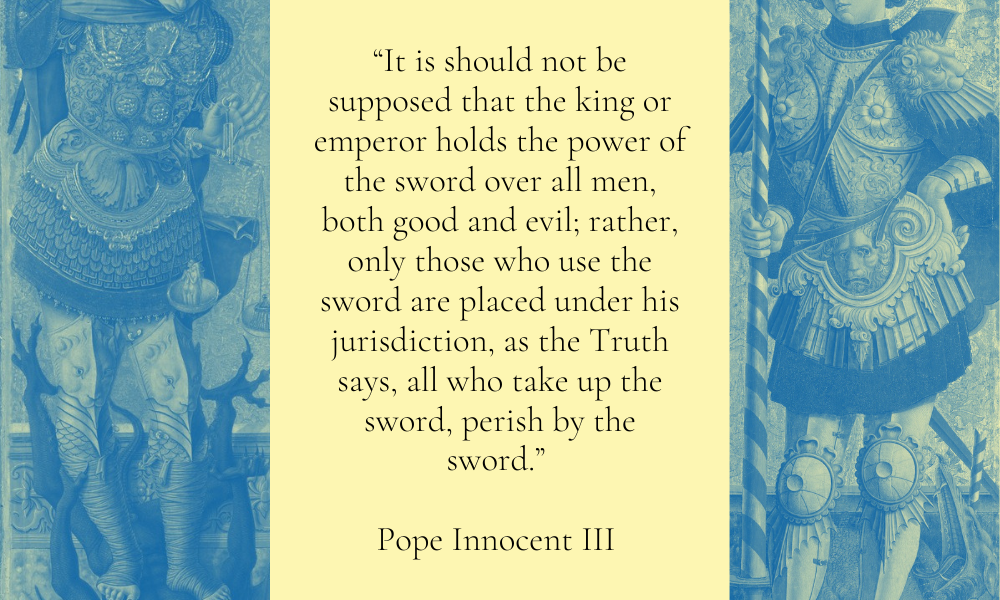
Within this framework, Innocent III could both claim universal dominion and acknowledge the limitations of his jurisdiction. [57] We can see why he insisted on the papal fullness of power and yet was so quick to acknowledge the relative rights of other monarchs. [58] This is not Innocent the cynical political realist; it is, rather, Innocent moving between the Old and the New, between the realm of sin and that of grace. It is why Innocent can remark in a number of places that Christian communities are often best governed when the papacy holds both spiritual and temporal jurisdiction directly over them, but without in any way asserting that this is the proper constitution for all Christendom or that all temporal jurisdictions are directly derivative of his universal temporal jurisdiction, even if all temporal power is ultimately fulfilled in the Order of Melchizedek. [59]
The Two Swords
It is at this point that we can begin to understand the famous doctrine of the two swords. The traditional interpretation of Luke 22:38, when the apostles said to the Lord, “behold, here are two swords. And He said to them: It is enough,” was that the two swords represented the Two Testaments. We can see, now, that this remained the case as the interpretation shifted in the High Middle Ages and the two swords became the temporal sword of royal power and the spiritual sword of priestly authority. The iron sword was indeed the sword of the Old Testament, the sword of the priestly kingship, the sword that was wielded against those who themselves wielded the sword. The spiritual sword was indeed the sword of the New Testament, the sword of the royal priesthood. We can see this clearly when we consider that the two swords did not, in fact, operate on the same plane. The priesthood of the New Testament dispensed the grace and the teaching necessary to move mankind from the Old to the New. Its sword, the censures of interdict and excommunication, were the cutting off of this grace. The sword was a negation—and it had no power outside the spiritual realm of the New Law, but rather governed the transition between the Old and the New. The temporal sword on the other hand was a positive action, it was wielded in the realm of the carnal, of the Old Testament, we might say. The priests brought spiritual death indirectly through the removal of the flow of grace into the soul; the kings brought carnal death directly through the cutting down of the body. The two swords, then, were really one sword, operating at different levels in the hierarchy of ascent to God, like how the Old Law and the New Law were really the single Divine Law.
As remarked earlier, there was finally only one sense of Scripture, the anagogical. Only the anagogical “settled” into a fixed and permanent position, because the anagogical was the end of Scripture. In the same way, there was finally only one order in society, the religious, because the life of Christian perfection in knowledge and virtue, contemplation, was the end of the whole social structure. The convergence of the spiritual life, the course of salvation history, and the structures of society was most clearly on display in the monastic vocation, with its method of lectio (historical), meditatio (allegorical), oratio (tropological), contemplatio (anagogical)—with its movement from the text to God, its movement from the world, through the law, through grace, finally to heaven, even while leaving neither the world, nor the law, not to mention grace, behind. In the religious vocation, the fractal nature of the cosmos is clearly on display. The monastery was the temple of God; so was the individual monk; so was the entire monastic society in its participation in the liturgy. [60] In the ideal, the monk, over the course of a lifetime of training, would internalize the Scripture and the liturgical texts to such a degree that he simply became a liturgical person, his entire life an act of worship. The letter of the Scripture faded away as it was memorized and interiorized and the rubrics and texts of the liturgy did the same. In the same way, the rule of the order was interiorized, so that the rhythm and life of the monastery was the very rhythm of the interior life of the monk, which was the very rhythm of reality, analogically connected to the life of the Trinity. This is ultimately what it meant for the monastery to be the temple. It was a microcosm of the temple-cosmos.
For Innocent, the contemplative life was the New Testament. The active life, both that of the secular clergy and of the laity, was still half in the Old Testament. [61] Like the anagogical with the senses of Scripture, the contemplative, liturgical life was both the source of the other orders and their end. Innocent sometimes expressed this very explicitly. The preaching of the clergy, for example, could only be efficacious if it flowed out of their contemplation, out of their participation in the monastic vocation, and its end was to share this participation with the laity. As we have seen the tropological life, the life of faith and charity, was itself the preaching of the Gospel. In a very real sense, the lives of the monks were the best sermons possible. But, because the Church was not yet the Church triumphant, these perfect sermons remained sermons of anticipation that had to be translated into language appropriate for the condition of the faithful. But the contemplative life lay also at the beginning. Salvation history was bookended with paradise, kingship and priesthood were bookended with Melchizedek, and the dynamic of reform was bookended with the monastic life. The reform movement of which Innocent was the apogee began in the monasteries and spilled out into society at large, shaking the Church out of its post-Carolingian stupor, and reminding it that sanctity was possible, that the perfect order of the liturgy was the model for all social order.
The three orders constituted a true hierarchy. The laity worked in the world of men and things, of time and change, ordering it toward a realization of timeless perfection and perfect peace, a perfection that was modeled and anticipated on earth in the life of the religious, but which was mediated to the laity only through the preaching, example, and sacraments of the secular clergy, the men who had a foot, in a sense, in both worlds. If the domain of the religious was Glory, that of the clergy was the New Testament, and that of the laity the Old. This is not to say that the laity lived in the Old Testament. Far, far from it. It is to say that to the extent that any man remained subject to coercive law through fear, to that very extent the laity ruled through the temporal sword, a rule forbidden explicitly to the clergy. In this lingering echo of the Old Testament, the laity become the anointed kings of Israel and the clergy became once again the prophets and priests of the law. But, of course, this “Old” was not integral; it was shot through everywhere with its end, with the realized “New,” with grace and its fruit, charity. Here, the clergy ruled. In this non-coercive realm of virtue, the truth poured from the clergy into the people that they might know justice and grace poured through the sacraments that they might instantiate this justice in their order. This is how the Spiritual was superior to the Temporal. Not through some boring notion of sovereign or martial hierarchy, where the will of the pope is commissioned to his temporal minions below, like a proto-Louis XIV declaring himself law incarnate.
Rather, each of the orders reached down to those below and pulled them up, an action that was only possible through the aid of the order above. The temporal sword could only fulfill its function to chastise sinners with justice because its wielders had already been pulled above their station by the grace and preaching of the clergy, an elevation they could never have achieved on their own. And, the whole social order, temporal as much as spiritual, was moving toward Glory, to the perfection of contemplation that would only occur in heaven, but which was anticipated in the monastic life.
The monastic life was superior to the life of the secular clergy and to that of the laity because it was, in a real sense, the fulfillment of both. The monasteries were full of both the ordained and non-ordained—clergy and laity—living an integral life of the elevation of the temporal ever deeper into the spiritual: work became worship and all of life became liturgy. In such a way the religious formed the model for the forces of power in society. The vision of their order lay at the beginning of the work of the laity and the clergy. But, it was also the end: contemplation was the fulfillment of human life itself.

And, it was also the means: The prayers of the religious saturated every nook and cranny of society and the efficacy of the monks’ penance dragged the sinful world forward, or rather, upwards. Monastic prayer and penance was integrated into politics, economics, family life, parochial and diocesan structures—it was the mysterious blood coursing through the veins of Christendom, similar to how, for Hobbes, money was the equally mysterious blood flowing through the body of the sovereign. As Foucault wants us to see the bodily discipline of the army penetrating ever deeper in the very soul of modern man, we ought to see here the peaceful and spiritual economy of the monastery subtly penetrating and conforming the structures of medieval society into its likeness.
With the above discussion in hand, we can return to Innocent’s use of the sun and the moon. He wrote:
Just as the founder of the universe established two great lights in the firmament of heaven, a greater one to preside over the day and a lesser to preside over the night, so too in the firmament of the universal church, which is signified by the word heaven, he instituted two great dignities, a greater one to preside over souls as if over day and a lesser one to preside over bodies as if over night. These are the pontifical authority and the royal power. Now just as the moon derives its light from the sun and is indeed lower than it in quantity and quality, in position and in power, so too the royal power derives the splendor of its dignity from the pontifical authority … [62]
We are in a position now to understand Innocent. The sun and moon in Genesis 1 had traditionally been understood exactly as the two testaments. [63] There is no reason here to compromise this reading. The royal power was the power of the Old Testament, of the priestly kingdom. This royal power was what it was because of its allegorical fulfillment in Christ. The temporal power was a participation in the priesthood of Christ, that is, of Melchizedek. The moon participated in the light of the sun without having any light of its own. But this didn’t render its participation a mere delegation. It was an analogical image of the sun, operating at a different level of fulfillment, of being. The existence of night, of sin, meant that the light of the sun could only fittingly be manifested through the participation of the moon. This means that the temporal power’s participation in the spiritual power did not render the temporal power dispensable or render the spiritual power capable of rescinding its light as if it was a conditional delegation. The clergy, after all, were forbidden to wield the sword. “The princes were given power over the earth, as the priests were given power over heaven.” [64] And the Church militant was exactly on earth. The sun and moon were necessary manifestations of the light of Christ until glory, where the heavenly Jerusalem “has no need of sun or moon to shine upon it, for the glory of God is its light, and its lamp is the Lamb.” [65] Until then, as Innocent explained to the emperor Otto, “your soul is bound to my soul, and thus your heart is bound to mine… for to us the two kingdoms of the world are given, who if we act together in concord surely, as the prophet testifies, the sun and the moon stay in their order, the crooked will be made straight and the rough will be made smooth.” [66] Through the hierarchical concord of the two luminaries, the pope explained, “the faith was propagated, heresy was confounded, virtues were planted, vices were cut down, justice was served, iniquities were repulsed, tranquility bloomed, persecution slept, and the barbarous pagans were subjected to the peace of the Christian people.” [67] Innocent’s evocation of the sun and moon limits the spiritual and confirms the temporal, even as it articulates their proper hierarchical relationship: the spiritual rules souls (which, of course, includes the bodies that the souls inform) and the temporal rules bodies and in via bodies must be ruled, even if their souls won’t be. [68] A holy king did not “submit” in subservience to a holy pope. He obeyed the pope because the pope was a conduit of truth and grace and in his obedience he participated in the pope’s kingship. In the order of charity, the pope, therefore, rendered the king’s office more powerful and more efficacious and did not undermine it. The king’s authority was not granted him by the pope as de jure power, as some sort of office or license. Rather, the pope’s spiritual power made true monarchical authority possible. Through the truth and grace with which the priesthood illuminated the monarch, the king was capable of the most profound de facto power possible—the power of a just ruler obeyed by virtuous subjects. When he had to use the sword against vicious subjects, when he had to go to war, this true authority rendered his actions legitimate, and aligned with the missionary efforts of the priesthood. The functions of the temporal power were not commissioned to the monarchy from the priesthood. Rather, the fulfillment of priesthood was the source of the fulfillment of kingship.
If the sun and moon show us the relationship between the spiritual and temporal powers in the order of charity, Innocent’s ratione peccati—on account of sin—rationale for papal intervention in seemingly temporal affairs concerns the realm of sin. [69] The ratione peccati is not a clever bid for sovereignty. Rather, as Innocent explains, David had been judged by no one but God because there was no one between him and God. This was the nature of the priestly kingdom. In the New Testament, however, because the Order of Melchizedek and so the unity of kingship and priesthood had been re-established in Christ, his vicar, the pope stood in the place of God. A sinning king could be judged by the pope, who was Melchizedek, who was both the source and the fulfillment of kingship. [70] As Innocent explained, “How then can we, who have been called to the rule of the universal church by divine providence, obey the divine command if we do not proceed as it lays down… for we do not intend to judge concerning a fief, judgment of which belong to [the king]… but to decide concerning a sin, of which the judgment undoubtedly belongs to us.” [71] But, we must see that this was the pope not of royal jurisdiction, not the pope as a fellow earthly king wielding the iron, temporal sword, but rather the pope holding the combined spiritual priesthood and kingship of the New Law—wielding the spiritual sword. He could intervene only when there was, in fact, sin, only when his elevation into charity enabled him to discern sin and preach the truth. As Innocent explained to one monarch, “our correction of you ought not be rejected, but rather accepted, because the father loves the son who he corrects.” [73]
Modern interpreters, of course, see in the ratione peccati a universal justification for unilateral action, a justification for sovereignty, where the pope’s judgment rules all. But this misses that part of the pope’s judgment must be that he does not, in fact, rule as a king at all. The pope was asserting that his office arose out of salvation history and governed over salvation history, not that it was the master of salvation history. If he lost faith, if he lost charity, if he lost hope, it is true, we must suppose, that he could turn the ratione peccati on its head and make it a tool of sin rather than a weapon against it. It would then, however, no longer be the ratione peccati, but a fraud, and the pope would no longer be Melchizedek but an imposter, a rival king among the nations and a rival priest among the idols. There is nothing “structural” that could keep him from so behaving. How could there be? Law structured the realm of allegory, not the realm of tropology. To try and structure the tropological through the allegorical, would merely be to deny that the tropological existed, to merely deny that charity is possible. To go one step further, to try and make sense of the Church from within the mere historical would be to deny even true law and to see in jurisdictional mechanisms nothing more than power and force. This would be merely to view all of salvation history from the vantage point of the Age of Nature. We could do this. This is what Hobbes does in his exegesis and political theory and there is nothing in the account I have just given that can’t, of course, be reduced to matter in motion or read through a lens of fear. Christ is foolishness to the nations.
How, however, is this all not just a more elaborate and complicated constitution? The answer is because the whole scheme subsists within a dynamic of ontological ascent, a dynamic of the people of God becoming more fully itself as it moves from the merely historical to the anagogical. Priesthood and kingship were moving toward their fulfillment in Melchizedek precisely to the extent that the people of God conformed themselves to Christ. This means that the offices of priests and kings oscillate between the temporal and the spiritual as they work to reform the Church, depending not on themselves and some sort of static jurisdictional arrangement, but on the progress of Christendom in its movement toward becoming the kingdom of God. Determining their relative position relied on discernment of the current situation. Politics was a practice of continuous discernment, of the interpretation of Scripture, which was, as we have seen, simultaneously the interpretation of the contemporary world. What was demanded of the king in one situation was forbidden him in another. A power claimed by the pope in one circumstance was exactly a power conceded by him in another. An assertion of superiority here, is met with an admission of humility there. This is what we see in Innocent’s rule.
Within the modern legal positivist mode of thinking, this leads to inconsistency, conflict, and confusion. Within the Biblical world of Innocent, however, this discernment is integral to the movement toward contemplation and so union with God, and he and the kings that surround him can only accurately discern to the extent that they are themselves ascending, to the extent that they think with the mind of Christ, that is to say, to the extent that they have already become Melchizedek. There is an analogical interval here. That which they must become is always just out of reach, and yet it is there; and yet its presence is the precondition of its own becoming. The preconditions for reform are that the Church is already reforming. This can be because faith, hope, and charity are theological virtues, the fruit of unmerited grace. The whole world was built on this foundation.
The truth of Innocent’s world, if it bears any truth, is naturally dependent on a move out of nature and into faith. If this move is made and so we suppose the world is how Innocent and his age claimed it to be, then we can see that the question of whether Innocent should be understood primarily as a pastoral pope or as a political pope is just a bad question. The political was a fundamental aspect of the pastoral. The movement of ascent to God passed always through the carnal, through the law, and on to liberty through grace. In fact, the preaching of the faith, the preaching of penance and reform, which is normally what historians place under the “pastoral” label, found their place most fully precisely at the bottom of the hierarchy of ascent, in the realm of the carnal, of mere history, which was the unambiguous realm of the sword of the kings. What this means is that to the extent that one was pastoral, one was political: to the extent that one was concerned with the conversion of the sinner, one was concerned with the wielding of the sword. To be of the order of Melchizedek was to be the fulfillment of both kingship and priesthood. If Innocent is right, then our denial of the hierarchical and dynamic ascent to God can only result in a stasis of fear and violence, a static Age of Nature that lacks the resources to climb out of itself, to even see beyond itself. If the narrative of salvation history is indeed the text of the cosmos, only this place in the plot will accommodate our modern conceits. We are trapped within the historical. But even here hope, the anagogical, is present. The historical bears within it everywhere the trace of God.

[2] Norman Tanner, Decrees of the Ecumenical Councils (1990) I:232.
[3] Revelation 21:22
[4] My understanding of the senses of Scripture is profoundly dependent upon my reading of Henri de Lubac’s Medieval Exegesis. De Lubac’s work is not merely a historical catalog of archaic interpretive hermeneutics. It is rather a theological explication of a vast and complex, yet nearly forgotten, approach to Scripture and through it to all of reality. It is not so much historical theology as it is theological history. As Hans Urs von Balthasar wrote of de Lubac’s work: “the theory of the senses of Scripture is not a curiosity of the history of theology but an instrument for seeking out the most profound articulations of salvation history.” The Theology of Henri de Lubac (Ignatius Press: San Francisco, 1991), 76. What I have learned from him, therefore, goes far beyond historical facts, to my understanding of reality itself. What he has shown permeates the current essay.
[5] As Thomas Aquinas would describe this traditional understanding a generation after Innocent: “In other creatures, however, we do not find the principle of the word, and the word and love; but we do see in them a certain trace of the existence of these in the Cause that produced them. For in the fact that a creature has a modified and finite nature, proves that it proceeds from a principle; while its species points to the (mental) word of the maker, just as the shape of a house points to the idea of the architect; and order points to the maker’s love by reason of which he directs the effect to a good end; as also the use of the house points to the will of the architect. So we find in man a likeness to God by way of an image in his mind; but in the other parts of his being by way of a trace.” Aquinas, Summa Theologiae I, Q. 93, a. 6, C. 2
[6] Hugh of St. Victor, On the Sacraments, Prologue to the First Book
[7] The allegorical sense is not what is nowadays called typology. Allegory is not a literary device used by the divine author in order to connect the Old Testament with the New Testament. Such typological devices would have to be considered a new depth to the literal sense of the text. With such a device, the text becomes more complex, indeed, but because we remain ultimately in the realm of history, the question remains: “what does it mean?”. The allegorical is the answer to that question. See: De Lubac, Medieval Exegesis, Vol. 1, 259-60.
[8] De Lubac, Medieval Exegesis, Vol. 2, 135, 155.
[9] Patrologia Latina [PL] 217:411.
[10] De Lubac, Medieval Exegesis, Vol. 2, Chapter 9.2; See also: Vol. 3, 100-1.
[11] PL 215:1182.
[12] Glossa on Leviticus 1. Quoted by St. Thomas in I-II, q.102 a.3 ad2.
[13] De Lubac, Medieval Exegesis, Vol. 2, 189.
[14] PL 217:607.
[15] PL 217:360-361.
[16] PL 217:483-484.
[17] De Lubac, Medieval Exegesis, Vol. 2, 138
[18] See, for example: De Lubac, Medieval Exegesis, Vol. 2, 32, 191-2.
[19] See: De Lubac, Medieval Exegesis, Vol. 2, 204-5. Also: Ian Christopher Levy, Introducing Medieval Biblical Interpretation: The Senses of Scripture in Premodern Exegesis (Baker Academic: Grand Rapids, 2018) 13, 22, 32-4, 70.
[20] Saint Bernard, St. Bernard’s Sermons on the Canticle of Canticles, trans. A Priest of Mount Melleray, vol. 1 (Dublin; Belfast; Cork; Waterford: Browne and Nolan, 1920), 1, 3.
[21] Quoted in: Chrysogonus Waddell, “The Liturgical Dimension of Twelfth-Century Cistercian Preaching” in: Carolyn Muessig, ed., Medieval Monastic Preaching (Brill: Leiden, 1998) 341.
[22] Gregory the Great, Reading the Gospels with Gregory the Great: Homilies on the Gospels, 21-26. Translated by Santha Bhattacharji (Fordham University Press: New York, 2002) 54-6.
[23] PL 217:330-331.
[24] De Quadripartita Specie Nuptiarum, PL 217:920-967
[25] De Quadripartita Specie Nuptiarum, PL 217:947; De Sacro Altaris Mysterio, PL 217:884.
[26] De Sacro Altaris Mysterio, PL 217:830.
[27] De Sacro Altaris Mysterio, PL 217:833-834.
[28] On Innocent’s spiritual reading of the Mass, see: Jones, “The Preacher of the Fourth Lateran Council,” Logos 18:2, 121-149.
[29] PL 217:673-680; English translation in: Vause and Gardiner, trans., Pope Innocent III, Between God and Man (2004), 55-63.
[30] Innocent wrote: “It will be a council in which in order to uproot vices and implant virtues, to correct abuses and reform morals, to eliminate heresies and strengthen faith, to allay differences and establish peace, to check persecutions and cherish liberty, to persuade Christian princes and peoples to grant succor and support for the Holy Land from both clergy and laymen, and for other reasons which it would be tedious to enumerate here, whatever, with the council’s approval, shall have seemed expedient for the honour and glory of the Divine Name, for the healing and salvation of our souls, and for the good and benefit of Christian people, may be wisely established as decrees of inviolable force affecting prelates and clergy regular and secular.” PL 216:823
[31] PL 217:487-490.
[32] Sermon for the Resurrection of the Lord, in: Moore, “The Sermons of Pope Innocent III,” Römische Historische Mitteilungen 36 (1994 ), 138–42.
[33] De Sacro Altaris Mysterio, PL 217:774
[34] Heb 7:1; PL 216:1012; 216:923.
[35] De Sacro Altaris Mysterio, PL 217:853-854.
[36] De Sacro Altaris Mysterio, PL 217:852.
[37] PL 215:1179; 216:1012-1013.
[38] PL 215:1179-1182; PL 216:1013-1014.
[39] PL 217:331; 217:1181-1182.
[40] PL 215:1179-1182; PL 216:1014-1015.
[41] PL 216:1055.
[42] PL 216:1184.
[43] De Sacro Altaris Mysterio, PL 217:779, 786-787; 217:482.
[44] PL 217:391; De Sacro Altaris Mysterio, PL 217:792.
[45] For the importance of holiness of life in the clergy, See: Jones, “The Preacher of the Fourth Lateran Council”; PL 217:482-484.
[46] Jones, “The Preacher of the Fourth Lateran Council”
[47] PL 217:516-517.
[48] PL 215:1180; PL 217:482; See also: Jones, Before Church and State: A Study of Social Order in the Sacramental Kingdom of St. Louis IX (2017), 315-338.
[49] PL 216:998.
[50] PL 217:678.
[51] PL 216:923.
[52] PL 215:1179.
[53] PL 215:1181-1182; PL 216:1014-1015.
[54] PL 216:1140-1141.
[55] PL 217:555-558.
[56] “It is should not be supposed that the king or emperor holds the power of the sword over all men, both good and evil; rather, only those who use the sword are placed under his jurisdiction, as the Truth says, all who take up the sword, perish by the sword.” PL 216:1183.
[57] PL 217:481-482; 216:1186.
[58] PL 216:1065.
[59] PL 216:923-924.
[60] See: Jennifer A. Harris, “Building Heaven on Earth: Cluny as Locus Sanctissimus in The Eleventh Century” in: From Dead of Night to End of Day: The Medieval Customs of Cluny (Brepols, 2005) 131-151.
[61] PL 217:391.
[62] PL 216:1186; 216:1184; see also: PL 216:1140-1141.
[63] See, for example: Biblia latina cum Glossa ordinaria, ed. A. Rusch, Strasbourg, 1480 ad Gen. 1:14-16.
[64] PL 215:1180
[65] Revelation 21:23
[66] PL 216:1162.
[67] PL 216:997-998.
[68] PL 215:1180; De Sacro Altaris Mysterio, PL 217:844.
[69] PL 215:325-328.
[70] PL 216:1055.
[71] PL 215:326.
[72] PL 217:1057.
[73] PL 216:1185; PL 216:1065.