
The Great AI Debate:
The following is a part of our ongoing blog series, “The Great AI Debate,” in preparation for New Polity’s event on AI in the Spring of 2027. For more on AI, please see our two magazines Issue 6.2/3 and Issue 7.3.
In his Rule, St. Benedict counsels monks that “idleness is the enemy of the soul. Therefore, the brothers should have specified periods for manual labor as well as for prayerful reading.” (RB 48.1) The line is “famous” because it uses the phrase lectio divina, for which webpages, books, and articles have multiplied in recent decades. The Tradition after St. Benedict clarified that lectio divina pertains to Sacred Scripture particularly, as Pope Benedict XVI commends to the whole Church (Verbum Domini, esp. 86-87). Nevertheless, the Rule of St. Benedict has wisdom that applies to all reading—and offers a critique of “reading” with generative AI.
We are often tempted to contrast reading and manual labor, treating them as mutually exclusive. Digging ditches appears fundamentally different from reading books. We think in terms of collar color: “blue collar” work for the less intelligent who work with their bodies and “white collar” who “work” with their mind. White collar jobs are performed in air conditioning and trade in intellectual property. Blue collar jobs are performed by the sweat of our brow, at least outside the Garden of Eden. We are worried AI will replace white collar jobs because AI appears to replace the need for reading. But this deserves deeper questioning. It is not clear that generative AI actually “reads” anything, nor that AI generates a “reading.” Furthermore, it is clear that St. Benedict would not accept such a simplistic contrast between reading and work.
The deep insight of the Rule of St. Benedict is that manual labor and prayerful reading are inseparable. The Benedictine charism is often summarized as ora et labora: pray and work. The goal is not to keep work and prayer distinct, but rather to work prayerfully and to work at praying better. The “et” is a true conjunction in the motto ora et labora, bringing together the realities of prayer and work in the life of a nun or a monk. The Benedictine life is one in which all work becomes prayer. In this sense, the goal is a return to the Garden, where it seems work was neither painful nor sweaty, and bodies were not in tension with minds. Out of the Garden there is, of course, tension between bodies and minds. Nevertheless, ora et labora anticipates the resurrection of body and soul together. The less we oppose reading and manual labor, the more we approach salvation.
The “and” is important for Benedictines, but we must also ask whether reading is somehow not work. Inasmuch as we have all struggled to read, we know that it is work. We must work to learn a language, to remain focused while reading, and to memorize enough of the reading to marvel over the truth it communicates. Reading takes time and energy. Reading is work. The promise of AI, like any technology, is that it makes work more efficient, but we must ask whether any AI, and especially generative AI, actually makes the work of reading more efficient. If I have only read a summary, have I actually done the work of reading? In many cases, I suspect I have not. But generative AI does not produce a true summary; rather, it produces a prediction in the form of a likely response based on the large language models. The words appear to be a “reading” because they are words, and I do read them. However, those words are not, in fact, the product of any person’s thoughts. Whatever I am reading, it is not the same kind of reading St. Benedict endorsed. Generative AI removes the work from reading, which would make engaging AI in this way the opposite of the Rule of Benedict and instead border on something we might rather call “Anarchy” or “Chaos” instead of a “Rule.” Would the slogan of Generative AI be ora non labora, pray but do not work?
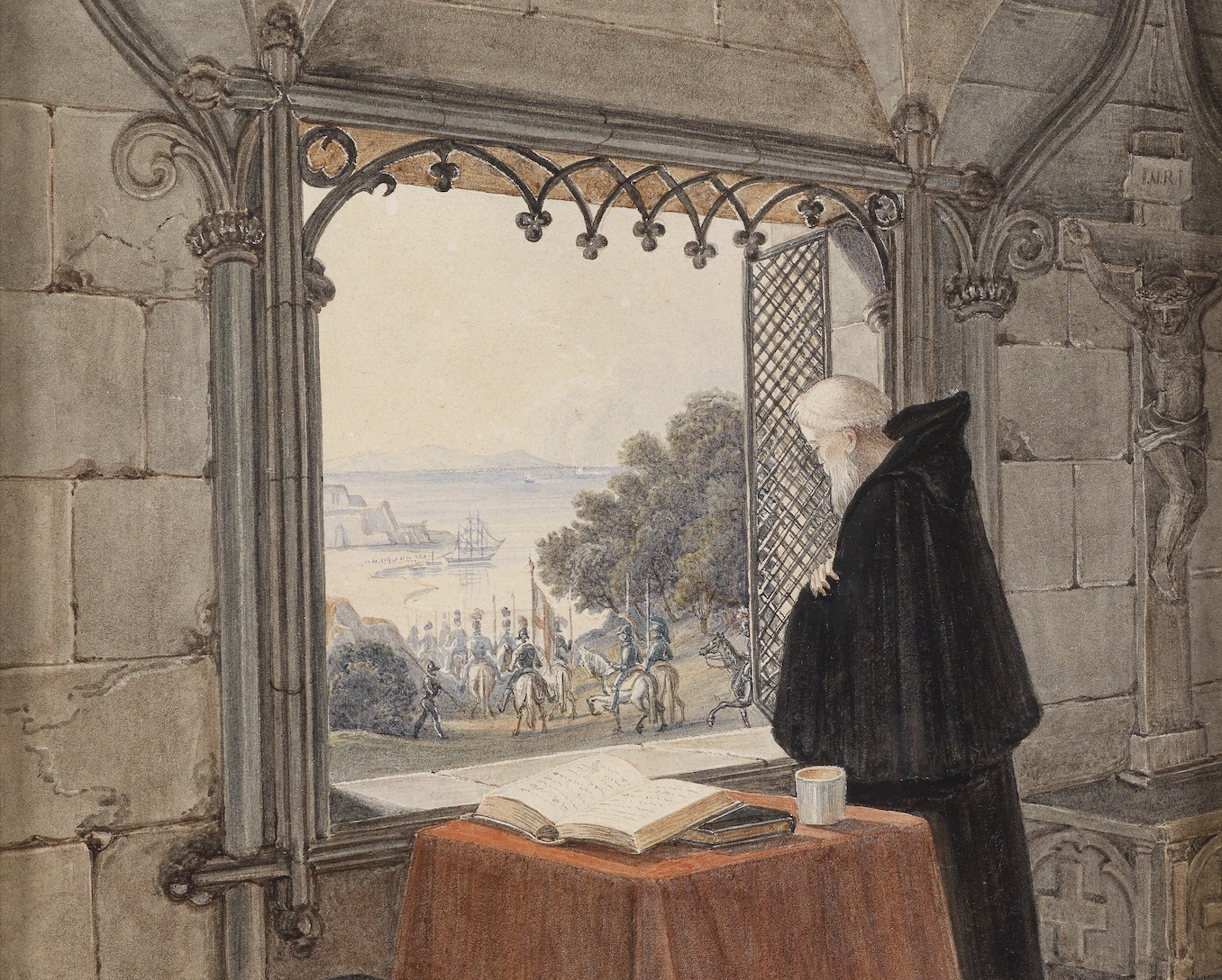
Not only is reading a kind of labor, it is a manual labor. Reading, until very recently, required holding a book in your hands. Using your hands is the definition of manual. Anyone who has tried to read while eating knows the choice between holding the page open and operating a fork. Anyone who has tried to read by flashlight has bumped up against the limits of no more than two hands per human person. Moreover, books are the product of both mental effort and manual labor. One writes her thoughts with her hands. Writing and reading are manual labors today, and even more so for St. Benedict, for whom the technology for writing and reading involved the hands in a more obvious way than today. Think of the scriptorium where monks labored to copy manuscripts—often of the very texts they would pray. Generative AI is not the product of human hands (i.e. the manual labor of writing), nor does it encourage the manual labor of reading.
How shall we arrive at the kind of life in which reading and labor are not opposed? To avoid idleness, the Rule describes a life that begins with alternating balance. The balance is at least twofold. First, the pattern of the Rule sets aside times to read and then times to perform other work. The pattern is punctuated by formal prayers (which include reading and working), meals (which also include reading and listening), and rest. Second, the pattern is adapted to the seasons so as to take into account longer daylight in the summer and longer darkness in the winter. The summer begins with work early in the day, reading later in the morning. After midday prayers and the midday meal, a period of work follows until evening prayer. The winter begins the day with reading, followed by work in the later morning. Midday prayers and meal are followed by reading and work. Easter provides the boundary between winter and summer. The beginning of October (Fall Equinox) is the boundary between summer and winter. The daily pattern alternates between hours designated for “reading” and hours designated for “working” not in order to keep them distinct from each other, but so as to advance each set of skills to such an extent that they are synthesized. The periods of reading include memorizing the text so that one may meditate on the reading while performing some other task. Meditation is one of the goals of reading; the memorization required for meditation means that one can “read” the text which she holds in her mind and heart without having to hold the book in her hands. The pattern is a training plan, a true Christian ascesis that integrates reading and labor. Generative AI seems designed to disintegrate reading and labor.
Time is calculated differently for Benedict since he follows the Roman sensibility that there are twelve hours of daylight and twelve of darkness, resulting in longer daylight “hours” in the summer than the winter. Translating from his sense of “hour” to our modern sense of “hour,” Benedict recommends approximately 4 hours of reading per day beyond the kind of reading one does during liturgical prayer and during meals (one monk is often designated to read out loud to the community during a meal). Relative to other Rules prior to Benedict, Benedict recommends more time for reading each day. We might attempt to summarize the wisdom of Benedict: balance your day such that you spend about one third of your daylight working with a book in your hands and approximately an equal amount of time working without a book in your hands. Artificial Intelligence appears designed to thwart this allotment of time and balance. The goal of AI is to spend less time “reading.”
Benedict is also explicit that Sundays be distinct from other days of the week. “On Sunday all are to be engaged in reading except those who have been assigned various duties.” (RB 48.22) For six days the Benedictine balance assigns roughly equal periods for manual labor and reading. On the seventh, reading is privileged. One promise of AI is that we can ask a complicated question and get a simple answer quickly, but Benedict tells us holiness includes reading slowly.
In addition to the weekly Sabbath which includes more reading than the other days, Benedict offers another distinction that separates a whole season from the rest of the year. “During this time of Lent each one is to receive a book from the library, and is to read the whole of it straight through.” (RB 48.15) If the pattern of reading for most of the year is “choppy” or partial, then for at least one ninth of the year (40 days), one’s reading should be dedicated to a single book. The goal of some AI is to read only snippets, while the goal of generative AI is to read a predictive “summary.” This disrupts the Benedictine balance that is meant to integrate reading and labor and introduces a puzzle about what precisely is being read.
The manual labor of reading and writing frames the question “What are we reading when we read generative AI?” in this form: “Is the text generated by AI the work of human hands?” There are many sophisticated computer systems that allow us to index and search the previous work of human hands. Generative AI, however, is “trained” and operates on a predictive algorithm rooted in large language models. No human hand (indeed no human mind, no human heart, and no human soul) produces the “text” which one reads when she reads the product of generative AI. While the computer which operates the program and even the program itself may be the work of human hands, the text which the AI produces is not. Generative AI, therefore, begins with a separation between the manual labor of writing and the process of reading. Furthermore, one must ask whether the reading involved is manual labor. On the one “hand,” generative AI purports to do the vast majority of the work of reading for you. Instead of you reading a book the whole way through, generative AI “reads” the book (indeed hundreds of “books”) so you do not have to read. What is generated by the AI is then projected on a screen. This raises another delicate question about separating the manual labor of holding a book from the act of reading. Is it even possible to fully engage reading when the “text” is displayed on a screen? Perhaps it is possible that generative AI is, in some sense, real reading, but the whole project begs the question whether it shares the Benedictine goal summarized as ora et labora, or whether AI fulfills or opposes Benedict’s Rule. Is it possible to use AI to avoid the enemy of the soul called idleness by having specified periods of manual labor and prayerful reading?
Benedict also counsels that “above all, one or two seniors must surely be deputed to make the rounds of the monastery while the brothers are reading. Their duty is to see that no brother is so apathetic as to waste time or engage in idle talk to the neglect of his reading, and so not only harm himself but also distract others.” (RB 48.17-18) Those who consider themselves seniors in our community must seriously ask these questions about generative AI. Does this form of “reading” engender apathy, wasting of time, and idle talk so as to neglect real reading? If so, AI is not only a harm to the “reader,” but also a distraction to others.
Thomas Humphries is a happy husband, proud father, professor at St. Leo University, and firefighter.