
The Great AI Debate:
The following is a part of our ongoing blog series, “The Great AI Debate,” in preparation for New Polity’s event on AI in the Spring of 2027. For more on AI, please see our two magazines Issue 6.2/3 and Issue 7.3.
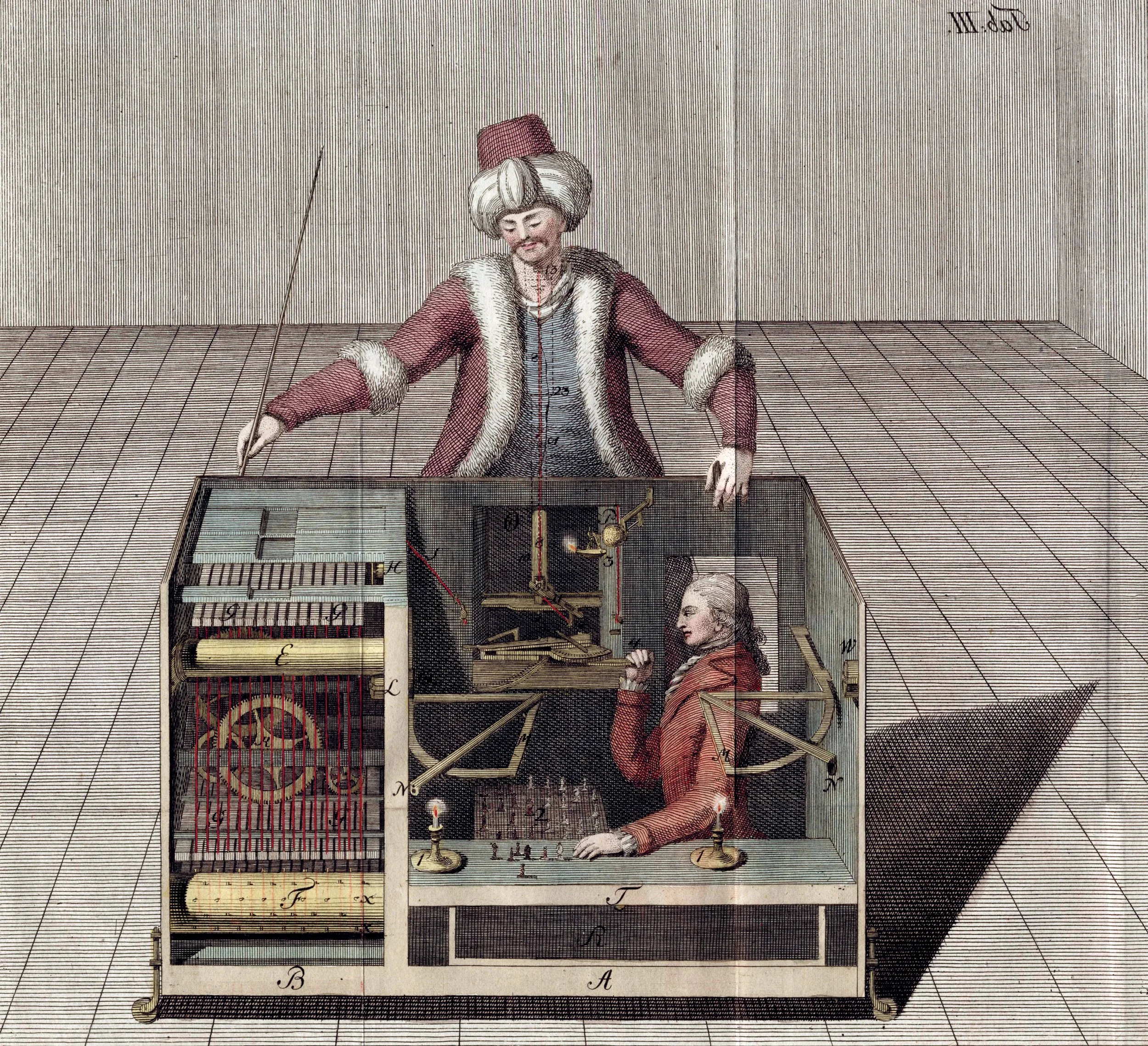
Artificial intelligence is no enigma. The concept is not new. Human history is filled with examples of the desire for automatons. From Pandora to Talos—to clay golems, the Mechanical Turk, Descartes’ robot daughter Francine, and beyond—we adore metaphor. The joy we receive from these fictions is no accident. Created in God’s image, we are imbued by our Creator with a power—justly inferior—to dream and subcreate in our own image. “Ah, but a man's reach should exceed his grasp, / Or what's a heaven for?” (Robert Browning).
But something about our current AI moment is strange. Surveying the archetypes of spiritless subcreations throughout history, we have no examples of automatons commanding anything close to the colossal capital—the size of whole nations—being invested in AI. By comparison, Ismail al-Jazari’s thirteenth century work, The Book of Knowledge of Ingenious Mechanical Devices seems quaint. What explains society’s sudden institutionalization of fantasy and this feverish desire to supplant God’s ex nihilo (from nothing) power of creation?
Two breakthroughs occurred at roughly the same moment in history, with mirroring effects: the invention of the birth control pill and the mathematical plausibility of artificial intelligence. Invented around 1941, synthetic progesterone found its final stamp of approval on May 9, 1960 by the U.S. Food and Drug Administration. And in the middle of these two dates, Alan Turing penned Computing Machinery and Intelligence in 1950, establishing the ‘imitation game’ following the war. This game, the Turing Test, was followed by John McCarthy’s coining of the term and propelling forward the field of AI. His and others’ research prompted Joseph Weizenbaum to create ELIZA, the first chatbot, in 1966. Artificial intelligence arrived precisely on the heels of widescale contraception.
The connection between the two technologies is not a coincidence. Marshall McLuhan taught us that “the effects of any innovation occur before the actual innovation itself.” This simply means that every tool is created in response to some societal demand; hidden, disordered, or otherwise. The yearning to exert control over the breeding of human beings preceded the inventions of both artificial intelligence and contraception. In fact, you could say that both were derived from a single cultural pressure, but created to service different human ends.
Why Americans in particular sought to stave off their own reproduction is up for debate, but not without some serious suspects. Feminism had been on the rise since the 1920’s, seeking to reorder marriage in order to make it more convenient to the workplace. Meanwhile, eugenics was a thriving Anglo-Protestant response to civil rights and the immigrant invasion of America. Mixed with the psycho-social changes of the post-World War II period, the American understanding of freedom was transforming. Having children—especially many children—will always sit uneasily with the tradition of possessive individualism, in which the freedom of the ego takes theoretical pride of place over and against the good of communities. These, and many other dramatic social changes, were opening the door to a brand new kind of disorder.
In the words of Weizenbaum himself: relatively simple technologies can “induce powerful delusional thinking in quite normal people.” No matter the magnitude of self-rationalization, we cannot fool God or derail nature. And there are few things more natural than our desire to create. Early in Genesis, we are given the birthright and charge to “Be fruitful and multiply, and fill the earth and subdue it; and have dominion over … every living thing.”“ There are two very important, but different words used here to describe that charge. The Hebrew verb, radah, usually translated to “have dominion,” explicitly denotes inheriting a rule, but also shares meanings with descending, wandering, and spreading. In contrast, the next verb kavash, or “to subdue,” literally means “to place your foot on the neck of your conquered enemy.”
It is not enough to rule. To accomplish both of these orders, man requires that he subcreate. To govern his people as equals, he needs certain virtues like justice, mercy, and an understanding of true diversity that is only possible through the subcreation and cultivation of his children. There is no other action that so thoroughly prepares a leader to lead than the ‘other-ing’ encounter of helpless and totally reliant children. Any father of many children who has worked for a childless boss understands this vividly.
Adam and Eve were obviously quick to overreach on kavash when they ate of the Tree of the Knowledge of Good and Evil. The forbidden fruit is, after all, that inordinate coveting of God, who, alone, creates ex nihilo. Is that not why the great Archangel rebukes Satan, “Who is like God (Mīkhāʼēl)?” It is a fitting irony: how many Michaels know their name is a question, not a compliment? The modern man desires—no, he demands—creation ex nihilo. After all, atheism is the ambition of ex nihilo. It is the practical implementation of god-creation, whether from building up within one’s self, as Nietzsche taught, or from a science that purports to supplant heaven. Out of this nothingness that we believe in and the fruit of nothingness we bear comes a tsunami of need. The soul requires an aim!
While we cannot create from nothing, we also cannot mute a gift from God. Nor can we store it away like some forgotten treasure. Our natural desires are obstinate and inconsolable—they demand of us. These bents cannot be tricked or diluted. They were known and established before time was sewn together. It is not by some accident that we love and bear children but by mandate from the Creator Himself. Through the incarnation, our “sub-creation has been raised to the fulfillment of Creation.” (J.R.R. Tolkien, On Fairy Stories).
When artificial contraception closes the door on life, the thwarted soul turns in desperation to heed some unseen call. Our sin “frustrates His design…and contradicts the will of the Author of life” (Humanae Vitae). Our desire to create is trapped in a sort of mimetic hell: “what must we bring into existence now?” Human beings are ultimately experiential creatures and demand regular interaction to balance our social, biological, and spiritual needs. We require a certain amount of human ‘busyness’ to keep our competing desires at bay. Instead we have empty homes, silent streets, and classrooms filled with brotherless and sisterless drones slowly addicting themselves to the very screens they will wed in their adolescence. The atmosphere of loneliness that we have inherited through contraception is absolutely unbearable for us as creatures. As a tool, birth control is both a rebuke of subcreation and the illusion of mastery over creation. Completely unaware—and in a way its makers could never have conceived—the sexual revolution unfetters pleasure from creation and gives birth to an entirely new raison d'être: the contriving of artificial life.
However, artificial life cannot satisfy our subcreative need to make a new person in our own image: no cute baby. Pride, envy, and all the other vices conspire to mock God’s ex nihilo power and, instead, unleash a monster made in the image and likeness of sin.
“How can I describe my emotions at this catastrophe, or how delineate the wretch whom with such infinite pains and care I had endeavoured to form? … fearing each sound as if it were to announce the approach of the demoniacal corpse to which I had so miserably given life. Oh! no mortal could support the horror of that countenance. A mummy again endued with animation could not be so hideous as that wretch. I had gazed on him while unfinished; he was ugly then; but when those muscles and joints were rendered capable of motion, it became a thing such as even Dante could not have conceived.” (Frankenstein, ch. 5)
Despite his belief, even Victor cannot create ex nihilo. He can only reassemble what God already made. His drive to subcreate—good in its own right—is intrinsically subverted by his malice and ambitions. Brad Gregory in the Unintended Reformation describes the 19th century battlefield: “God simply no longer had a place in the workings of the world, whether spatially or causally: if all natural events were adequately explained by natural causes, God was redundant…Laplace’s famous quip to Napoleon in 1802 when asked about the place of God in his physics [was]—‘I have no need for that hypothesis.’” The shaking off of God is the true deformation of subcreation. To Victor, God was redundant—and so Victor became god.
Compared to Frankenstein, our modern situation is pathetic. We are so lonely and so desperate to create in our image that we imagine a tool—artificial intelligence—that does not yet exist (and cannot exist) and vociferously roleplay with its inferiors (e.g., ChatGPT or Claude). Uncooperative, we toil with subpar automatons in some vain hope that we might one day accomplish our fondest imagination: creation ex nihilo without imago Dei—a dreamland of childless, recreational pleasure without any burden of work, suffering, or consequence. The desire for subcreation echoes, but out of sync with the master of the cosmos. Ever more, then, our hearts will burn with that yearning for creation that only the Creator can satisfy.
Michael Marinaccio is Executive Director of the Center for Responsible Technology, based in Washington, D.C.