
Politics podcasts
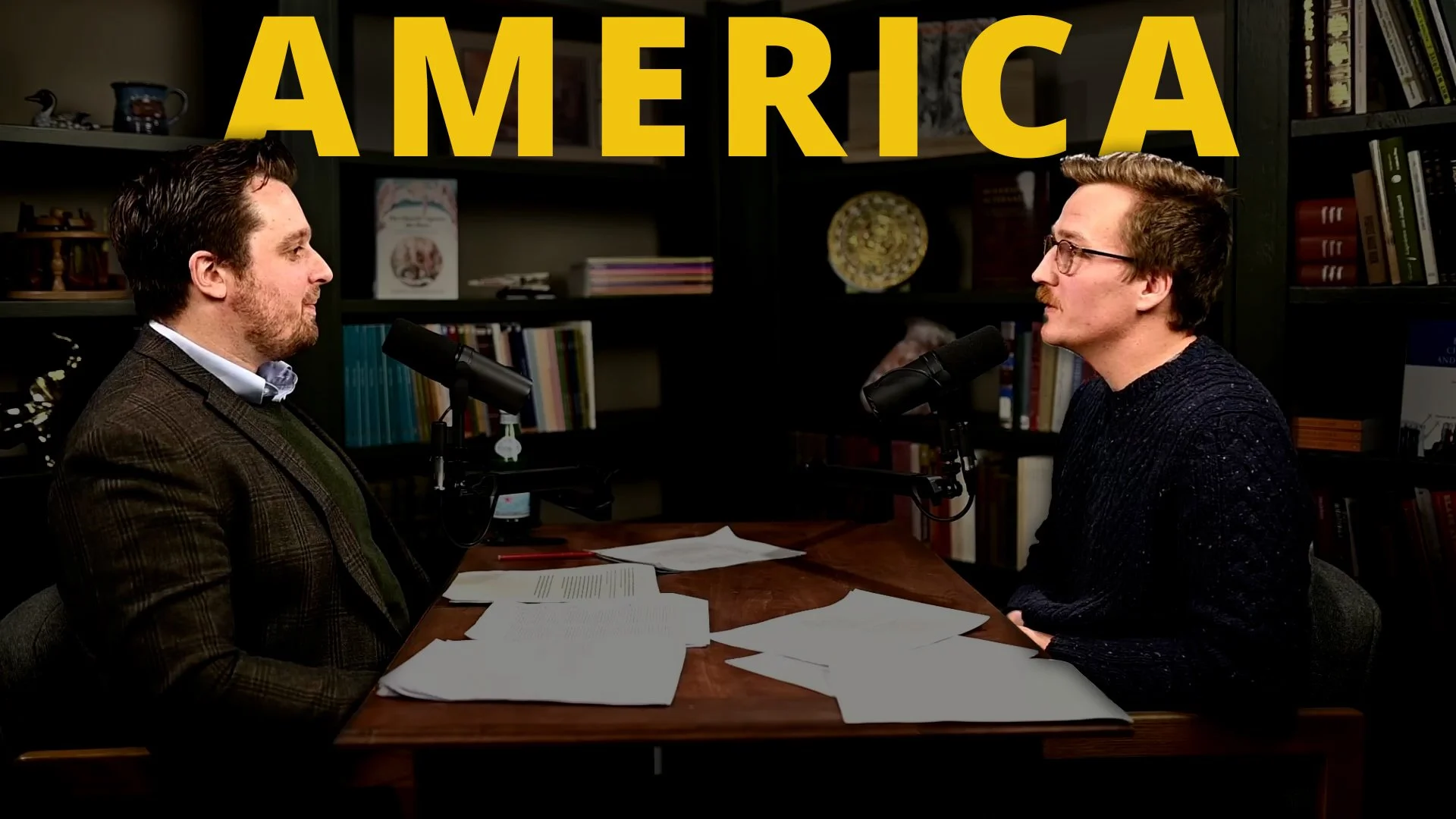
America is a special place. And, it even has it's own heresy. In this podcast, Reuben Slife and Marc Barnes discuss Leo XIII's condemnation of "Americanism," and the controversy that it caused. Some US bishops replied to the Pope that no one actually adhered to Americanism, and that it was effectively a "phantom heresy." But, is there something particular to the American way of being Catholic that needs correction? How does this teaching on Americanism relate to America today, on the 250th anniversary?
Magnifica Humanitas has been called the "AI Encyclical," but there's far more to the document: a thorough analysis of Catholic Social Doctrine, an extensive treatment of modern warfare, and how power works in the world today. In this podcast, Alex Denley and Andrew Willard Jones discuss the political philosophy of Magnifica Humanitas, and how the Pope's analysis helps us to understand our future with AI, how the powerful will use it, and what we as Christians can do about it.
What does it mean to be holy in America? David L. Schindler, for forty years editor of the American edition of the international theological journal Communio (founded by Joseph Ratzinger, Hans Urs von Balthasar, and Henri de Lubac), devoted much of his career to a theological analysis of American culture. "America in the Mystery of Christ and the Church" brings together Schindler’s key writings on American culture, presenting his profound and multi-faceted thought in full. It contains a complete chronology-bibliography of his works on America and of the debate with Neuhaus, Novak, and Weigel. In addition, an extensive, original Critical Introduction gives a synthesis of his thought, with special attention to the theme of holiness and to the easily-overlooked positivity of his pursuit: to purify, in Christ, the uniqueness and gifts of the United States.
The Iran War is close to entering its third week, and hostilities continue to escalate. Off-ramps for de-escalation are closing and the American public is, largely, unsupportive of the war. In this podcast, Alex Denley hosts a roundtable discussion with three professors of the College of St. Joseph the Worker, Dr. Andrew Willard Jones, Dr. Alex Plato, and Dr. Jared Goff, on whether the Iran War fits the criteria of a just war according to Catholic Social Teaching. They also discuss the circumstances of the war, the stated objectives of the Trump administration, and whether modern warfare is capable of being waged justly.
We are excited to announce our next New Polity Magazine: Issue 6.4 on The Critique of America, featuring essays by Reuben Slife, David L. Schindler, Michael Hanby, John Byron Kuhner and more. In this podcast, Marc Barnes and Michael Boland discuss the critique of America, structures of sin, and the idea of the American people.

America was a place of untold wealth in the post-war period. But today, many small towns are faltering and facing financial collapse. In this podcast, Strong Towns founder and president Chuck Marohn sits down with Marc Barnes and Jacob Hyman to discuss how this collapse came about, and how to rebuild the small town.

In this podcast, Alex Denley and Professor Rocco Buttiglione discuss the problem of globalization, mass migration, and populism. Post-war globalization brought a great increase in international trade, cooperation, technical and educational development, and cultural sharing. However, with open trade came the loss of manufacturing and industry in the West, and the emptying of the working class. Along with mass migration, the people grew to resent their global elite. Professor Buttiglione discusses the Church's response to globalization, and the need for a new elite who care for the people.

Liberalism is on the defensive. Political discussion is shifting from “what’s wrong with liberalism” to “what’s true about politics”—to the question of what exactly must displace liberalism. In The Politics of the Real, D. C. Schindler takes us to the definitive metaphysical roots of liberal politics: the modern reversal of the priority of act over potency; the modern privileging of empty possibility over flourishing perfection. In this podcast, Michael Boland and D. C. Schindler discuss liberalism, and how we can build a politics of the real.

Professor Rocco Buttiglione and Dr. Andrew Willard Jones discuss the rise of nationalism and populism both in Europe and America. What is the proper Catholic understanding of the peoples and nations? How should we navigate a global economic order within modern nation-states? They discuss how the Church has responded to this situation, and how the theology of the peoples can provide an answer.

D. C. Schindler argues that the loss of authority is the greatest of all human crises. When Nietzsche speaks of the death of God, which will lead to calamities, Schindler sees the great loss of authority. Liberalism's dismantling of any authority in favor of the sovereign individual has lead to the collapse of social order and the pursuit of a genuinely common good. In this podcast with Andrew Willard Jones, D. C. Schindler discusses authority and how it can be recovered.

We live in a disillusioned political age, one where old liberal arguments no longer have hold. Conservatism has moved into a right-wing politics which no longer sees the value of Christianity. Lost in an ostensibly equal mass, individuals have experienced a loss of identity. New developments in technology, and especially AI, present an existential threat to human agency. In our time (2025) and place (America), we need the social doctrine of the Church.

In this podcast, Marc Barnes and Reuben Slife discuss the latest New Polity magazine, Issue 6.1, and specifically the translation of Alberto Methol Ferré's striking essay "The Church, People Among the Peoples." Is the Church a visible people, or a people among the peoples? How does the Church overcome oppositions, universal-particular?

In honor of the new Pope Leo XIV, and in celebration of the 134th anniversary of Rerum Novarum, Alex Denley and Andrew Willard Jones discuss the pontificate of Pope Leo XIII and the birth of modern Catholic Social Teaching.

In honor of the passing of the Pope, Marc Barnes and Reuben Slife discuss the life of Francis and the theology which he embodied: the theology of peoples. They also discuss Rocco Buttiglione's new book Modernity's Alternative and how Latin America formed the Pope's pastoral life and mission.

In the 20th century, a movement of priests and laypeople sought to find a way past the clash of ideologies that wracked Latin America. They found a solution in Latin America itself, which was born out of the conflict between Europeans and natives when, with the appearance of the Virgin Mary at Guadalupe, the grace of God forged one, new people out of strangers and enemies. This movement—called “theology of peoples”—focuses on the reality known as “a people.” Every human person belongs to a people. And every people has a “world”: the way it makes sense out of life, work, love, and the uncertain future. In this podcast, Reuben Slife and Marc Barnes discuss Modernity's Alternative by Rocco Buttiglione.

For the last five years, the Political Right has been debating over a program for regime change in America: should populism be used to construct a new elite class? Should a new administration retire all government employees? Can the bureaucratic state be maintained but filled with new conservative staff? In this podcast, Alex Denley and Dr. Andrew Willard Jones discuss subsidiarity as the solution to this debate, and how it provides a program for genuine regime change.

What is the meaning of national identity? Does strong national identity necessarily create a hostile relation with other nations? In this podcast, Marc Barnes and Alex Denley discuss Joseph Ratzinger's short book "The Unity of Nations." Through a discussion of the political theology of Origen and St. Augustine, Ratzinger shows how the early Christians viewed their relation to the nations, and Christianity's nation-unifying gospel.

In this podcast, Marc Barnes and Alex Denley discuss Joseph Cardinal Ratzinger's book "The Meaning of Christian Brotherhood." What is distinct about the brotherhood of Christians? Are there different ethical modes of acting to the brother and the non-brother? How does this impact our understanding of peoples and Christianity?

The Church sees the world as God’s good and harmonious Creation, a primordial peace. In his acclaimed book Before Church and State, Andrew Willard Jones revealed that society in the High Middle Ages was a striving toward liberation by grace, which led to subsidiarity. In The Church Against the State, he argues that this uniquely Christian political form is still with us, present in our love, our courage, and in all that is noble within us, brought to new life through the Church. In this podcast, Marc Barnes interviews Andrew Willard Jones on his new book The Church Against the State.

All the energy and vitality today is on the political right; the old conservative reactionary stance has been replaced with active, rival voices aimed at constructing a new regime. One such voice is Bronze Age Pervert and his followers. Through their series "The Politics of Paganism," Alex Denley and Dr. Andrew Jones have explored the Nietzschean proposal, arguing that it is doomed to failure. The pagan cosmos is a closed world which cannot provide the freedom and vitality that Nietzsche extols. In this final episode, Alex Denley and Dr. Andrew Jones discuss the failure of the Nietzschean alternative and the open world of a Christian political order.

Why do we not feel free? As modern liberalism continues to isolate and divide, our common experience is a lack of freedom, of being constrained and enslaved. But, how can true freedom be restored? In this episode of the Politics of Paganism, Alex Denley and Dr. Andrew Jones discuss the New Law and how grace restores true freedom.

St. Thomas Aquinas presents salvation history in three stages: The Age of Nature, the Age of Law, and the Age of Grace. The pagans are stuck within the age of nature; fallen humanity inevitably declines into idolatry and slavery. But, God has a plan for saving man. From the time of Moses until Christ, God's chosen people are in the Age of Law which points forward to the coming of Christ. In this podcast, Alex Denley and Dr. Andrew Jones discuss salvation history and the culmination of the Age of Law in the Cross.

The pagan cosmos is a closed world: the city is never truly self-sufficient, requiring natural slaves and war; regimes rise and fall cyclically; the regime's justice is never true justice. In the Treatise on Law (ST I-II, Q.90-108), St. Thomas Aquinas presents a different vision: the open world of grace. God orders the world through the eternal law; rational creatures participate in providence through human law; divine law is necessary to bring man to his final end. In this episode of the Politics of Paganism, Alex Denley and Dr. Andrew Jones discuss how St. Thomas' vision of law answers the closed world of the pagans.

Plato and Aristotle argue that aristocracy is the ideal regime, but it never lasts for long. What's most powerful wins, and the masses are always the most powerful in number. Eventually, every pagan regime declines into the production of idols and temple slavery---whether Egypt, Greece, or Rome. In this episode of the Politics of Paganism, Alex Denley and Dr. Andrew Jones discuss this decline and what brings it about.

Medically-assisted suicide bills are being introduced in states all over the country. Proponents say that it allows people to "die with dignity" and that it gives people "autonomy." But, the actual reality is far darker. In states like Oregon and California, people have been denied life-saving treatment and recommended suicide. People with disabilities and depression have been pressured into suicide.
In this podcast, Pat McGeehan, delegate of West Virginia, Marc Barnes, and Alex Denley discuss the dangers of legalized medically-assisted suicide.

Aristotle's "Politics" is full of deep insight: politics as the architectonic science, the mixed constitution, happiness as the end of the city. But, there's a group which is excluded from human virtue; namely, the natural slave. Alex Denley and Dr. Andrew Jones discuss how the "natural slave" reveals the structure of Aristotle's just city: a limited class of citizens over an unspecified amount of slaves. And, that the despotic relationship extends into the mixed constitution of the citizens. The masses believe they are ruling in a democracy, the notables believe they are ruling an oligarchy, and the one, true philosopher-statesman rules the whole; each class instrumentalizes the other. They discuss how this doesn't vilify Aristotle, or presume nefarious intentions; this is what a science of a pagan political order demands. Ultimately, it is this structure that Christianity transforms from both within and above.

Plato presents a vicious circle that every regime goes through: from a limited aristocracy, to a timocracy of honor, an oligarchy based on wealth, a democracy based on liberty, and, finally, the tyranny of the one against all. While some regimes may be more just than others, it is bound to collapse eventually. Alex Denley and Dr. Andrew Jones discuss Plato's description of the individual and his regime, the circle of regimes, and how Christianity can provide an answer to the circle.

Everyone has a sense of what is just and unjust, but what is the source of justice? In this episode of "The Politics of Paganism," Alex Denley and Dr. Andrew Willard Jones discuss Plato's "Republic." Through a discussion of the luxurious city, the myth of the mixture of the elements, the Allegory of the Cave, and finally the Philosopher-King, Alex and Andrew show the tension in Plato between relative and absolute justice; between the shadows of justice in the city and true justice that the philosopher contemplates.

Death comes for everyone. For the Christian, death is the passage into eternal life; but, what about for the Pagan? Alex Denley and Dr. Andrew Willard Jones discuss the problem of death for pagan regimes. Using St. Augustine's "City of God," they discuss Cain's murder of Abel, the founding of the city by violence, the inferior law of violence, and the overturning of death by Christ.
In this podcast, Marc Barnes and Reuben Slife discuss Pope Pius XII’s 1939 letter to America on the 150th anniversary of the establishment of the hierarchy of bishops. They discuss both Pope Pius’s praise for America and his warnings regarding the degradation of the family and cultural decline of the pre-war era.